Jung cannot substantiate the heroic interpretation of alchemy, as the rescue operation nowhere take place. To hasten the King's demise is the proper thing to do. This will eventually "rescue" him. Jung interprets alchemy according to the notion of "confrontation with the unconscious", but the dying and resurrecting King is not the ego. It is the self.
I think psychologizing the Old (or the New) King of alchemy is difficult. It doesn't map perfectly to either Self or ego, yet touches on both. Maybe the Old King is a construction of the old ego as well as its relationship to the old figuration of Self. I don't think the Self really changes substantially. Yes, it is complex, dynamic, and living . . . and so it is always changed. But it is the
Self because it is always what it is no matter how it changes. Nature is always Nature no matter how it changes, even as it dies and is "reborn", it is Nature. Nature is that which is always dying and being reborn, always reorganizing. It think the Self appears to change depending on what it relates to (or what and how the ego relates to it). So, really it is the ego's perception and relationship to the Self that changes. I would even say (and have said) that the egoic thing that changes is the
languaging of the Self. Ego is constructed by language. At first it is languaged to us, and eventually (and to varying degrees by individual) this languaging proves to be inadequate to express the Self/Other that we also are. A new language is needed in which to be and become, a personal, "mythic" and living language. In my own theoretical vocabulary, I call that "Logos". Alchemy is a Logos or a Logos tradition, but an individual developing a Logos must personalize it, must co-create it along with the Self (Nature). The Art (as in the alchemical Work) is a personal languaging endeavor . . . and I think alchemy's best symbol for this is the
filius philosophorum, Son of the Philosophers. We co-create Logos like birthing and raising a child.
There is also a sense in which the Work redeems "God" or the Self. But I think Jung was very much aware of that and in fact used this as a cornerstone in his own psycho-theological fantasies. Where the ego is transformed, the Self is redeemed and rejuvenated . . . because ego is the medium between Self and environment. Ego can be a disease that strangulates the Self (more precisely, the Demon-possessed or -oppressed ego can be a disease). The Old King of alchemy is characterized by his sickness and by his capacity to "pollute" and "poison". The foul sulfurous odor is often referenced in alchemical texts and associated with the Old King's poisonousness or disease.
According to
Wikipedia, sulfur was being extracted from pyrite (fool's gold) from the 3rd century by the Chinese . . . and when sulfur is heated enough, it melts into a blood red liquid (a la the famous "Red Tincture" of alchemy). It all makes an interesting allegory for the Old King who has "within it" a New King or non-intuitive inner form (yellow solid that melts into red liquid).
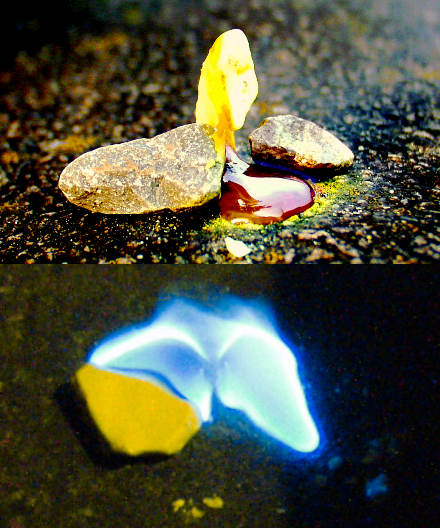
molten sulfur above; burning sulfur below.
My personal experience (as an artist and writer who had a long devotional period of writing about Old King figures and aspects) is that we might do work which seems to be directed at transforming an Old King (as a version of the Self), but this work indirectly functions to reconstruct the ego as a languaged object that relates to the Self. My book of poems
What the Road Can Afford goes about dismembering, cooking, and dissolving divine and quasi-divine Old King figures with an "alchemical heat". I saw theses Old Kings as related to the vision of the writer/artist that I was struggling not to be: a kind of Old Testament Creator-God. I recognized that this creation power was illusory and "poisonous" and that I was infected with it. So I went about "alchemically punishing" this aspect of the God and myself. I poured acid all over it and turned on the heat, but made sure to contain this all in the vessel of the poems (and the book as a whole).
Through the process of writing this book (over about seven years), I gradually became a knowing co-creator who could step aside from my "creative power" and its delusional poisons and facilitate something Other . . . the Self, that is. But I never really imagined that I was changing God or the Self. This was always metaphorical. I think I was trying to figure out how to contain, facilitate, or "alchemically perfect" the Self/Nature with my Art . . . not to create something perfect and golden or to be able to sip an Elixir that cured my suffering. But to find a way to love and commune with this Other (that is also "me") . . . and not just that Self-as-Other, but also others in general. The work of art was a process of developing a functional and valuating relationality.
The alchemical aspects of my poems were largely unknown to me while I wrote them. I had had some contact with alchemy through Jung, and it "inspired me" in many ways, but I had no conscious understanding of the alchemical process and therefore no ability to insert it into my poems as some kind of device or reference. It's really quite astonishing (to me, at least) how deeply alchemical my book ended up being. All Nature . . . where Art provided merely heat and containment.
The problem is that we get a warped view of the spiritual path. The way of the cloistered complentative is no alternative to most people. Instead the "alchemical" spiritual way can provide an answer. But if it becomes psychologized and misinterpreted it obviously has very damaging consequences. This issue is not merely a dispute over the misinterpretation of alchemy, it concerns the immensely important issue of how to find our way on the spiritual path.
I would agree that alchemy presents a very useful (and still very relevant) metaphor for leading the "symbolic life". But it also presents (at least) two major complications. First, it is so densely symbolic and convoluted that one has to have that kind of mad hermetical obsession to be able to sort it out (a sorting out that requires a good deal of projection and reverie, as well). There is not enough consistency in different renderings of the alchemical opus for most people to find a solid ground for interpretation in alchemy. This alone creates many intellectual (and spiritual) dangers. For instance, although I am very grateful to Adam McLean for his important online contributions to alchemy studies, sometimes his approach is too dogmatic for me. He criticizes Jung's interpretations of alchemy, and he does so on many valid grounds. But ultimately he faults Jung for psychologizing, and this I have to take issue with. Here, I think Jung understood what the alchemists were up to better than McLean or someone taking a more "scholarly" (or equally, a more "spiritual") approach.
What I mean is that there is no absolutely consistent tradition in alchemy that a "great scholar" can suss out, extract and lay before a reader's feet. There are many, many variations in alchemical thought, many different ways of saying the same things . . . and the alchemical writers made no real attempt to "get together" and make sure they were consistent or "on message". Jung does stray from some of the most traditional elements of the opus (e.g., conflating prima materia with pre-Work [and practically pre-ego] chaos, Nigredo with depression and "unconsciousness", and Coniunctio with transcendent hieros gamos). And this straying works to the detriment of Jung's psychologization. Here, he should have listened more willingly to the alchemists instead of leaping at what he thought were modern, psychological parallels.
But in trying to psychologize alchemy, Jung was also staying true to the spirit of alchemy, which essentially holds that there is no real "alchemical scholarship". That is, alchemy can only be understood experimentally and creatively. It is an Art, not an
artifact. One must live the Work in order to study it . . . and no two people will live this Work in precisely the same way. One may learn a bit from one previous alchemist and another bit from another alchemist, but this cannot merely be taken as is and reused (where texts like
Splendor Solis and
Rosarium Philosophorum collect classical alchemical quotations together, these collections read more like inspirational mantras or koans than coherent philosophical arguments). Every opus is original. Only the general structural dynamics are consistent (i.e., not the order of stages or processes but the most general structures like
solve et coagula and the Black, White, Red sequence). That the derivation of the Philosopher's Stone tends to read like a recipe (if only a very muddled one) is a deceptive temptation, a wish that cannot be fulfilled. To imagine that the opus is a recipe and not a labor is to go chasing madly after eternally elusive gold and thinking the material wealth of fantasy is the real valuation that awaits the successful "adept".
I contend that Jung
practiced alchemy (in his alchemical writings). He was not a scholar of alchemy, but an alchemical experimentalist, an artifex . . .
because he was a psychologizer. All alchemists were psychologizers (and neither scholars, per se, or spiritualists). This is something McLean doesn't seem to recognize or give Jung credit for. Although Jung at times over-asserted the "unconsciousness" of the alchemists, I think he was largely right about the projection of archetypal psychodynamics into the chemicals and metals. One can project like this without being truly unconscious, though. Projection can be a devotional or spiritual act (i.e. a "reverie"). And when Jung wrote his alchemical books later in his life, he was also swept up in reverie or in a kind of mystical participation with his subject matter. For this reason, Jung's alchemical writings should not be read as "alchemy scholarship". They are, in fact, alchemy experiments . . . opera.
Regrettably (especially for Jungians), Jung's alchemical opera represent devoted but ultimately (although not utterly) failed experiments. They do not generate functional Philosopher's Stones. But since alchemy (like science) benefits from failed experiments, this is not really a flaw. The problem is that Jungians want to see these works of Jung as Philosopher's Stones, and this makes for bad faith. Jungians become pseudo-alchemists, frauds, charlatans, or "charcoal burners" who deal in fool's gold. Many Jungian problems derive from not taking Jung and his thought scientifically. He is taken religiously, and so must be either right or wrong, a true or false prophet. If he were taken scientifically, we could actually learn from his experimental "failures". These failures would enrich us and allow analytical psychology to keep progressing. But instead, Jungians have typically chosen to blindly defend Jung's experimental ideas as "true prophecy" . . . which is one of the reasons that analytical psychology has been deteriorating and moving toward assimilation into psychoanalysis (where Jung is a "false prophet") on one hand and New Agism (where you can be a "true prophet") on the other.
I do not object to the psychologization of alchemy. In fact, I feel this is the only honest and non-delusional way to pursue an alchemical project today. We cannot find the Stone in old alchemical texts; we must make our own Stone. So only a modern language will suffice. The archetypal "gods" and structures (i.e., Nature) still live in psyche, even as they can no longer be found in chemicals. Equally, although these "divine" principles and intelligences do not really exist in matter (as we now understand matter), principles of complex, dynamic organization still do. The time for the alchemical imagination is still ripe, perhaps riper than it was since before the Enlightenment and the rise of sciences like modern chemistry as a form of materialistic rationalism.
But the second major complication for the modern use of alchemy is a matter of something we are not really all that ready to deal with, I think. The scientific study of nature now allows us to imagine and language complexity (which is the root to a valuation of matter akin to that in the alchemical project). But our human spiritualities are still quite archaic. I don't think we have yet found a truly modern form of spirituality. Jung's psychology points in a viable direction, but ultimately comes up short, especially in Jungianism (post-Jung) where Jung's ground-breaking spiritual psychologization has regressed to more conventional spiritualism and supernaturalism.
One of the causes (although I don't find it a suitable "excuse") of this spiritualistic regression in Jungianism is no doubt Jung's own regression late in life (especially after his heart attack) to a more conventionally spiritual position. It wasn't an absolute regression, but it was a slip backward into less-modern and more romantic thinking. Jung no doubt felt he deserved this comfort and had earned it after years of psychological devotion to the spiritual. Regrettably, it jackets the unique spiritual-scientific amalgam of Jungian thought into a more run of the mill occult spiritualism. As a psychologizer, Jung was truly modern and pioneering. As a spiritualist, he was merely a romantic, an anti-modernist. I think the quasi-scientific psychologizing trend in Jung's thought was his most profound contribution. But Jungianism has fallen away from Jung's more truly alchemical experimentalism and phenomenology in favor of more dogmatic and spiritualistic beliefs.
But this is what most Jungians today prefer (where "one's bliss" is followed instead of truth, belief eclipses knowledge). Jungianism after Jung has failed to be truly experimental and (as Jung recommended) experiential. In today's Jungianism "experience" is confused with belief and the "active imagination" that swirls around that belief. Believing is not doing . . . and this is another way in which the meanings of alchemy are lost on modern Jungians. Alchemy is not a religion, though. It is not meant to be believed in. It's a creative, experimental endeavor. It is not a truth to uncover but a mode of doing. Alchemy is similar to storytelling in the oral tradition. Each new teller reconstructs the stories they hear and inherit, revising them both on the basis of what they like most and also by what their audiences like the most. Alchemy shows the same kind of variations that folktales show. The written texts preserved are like specific renderings of the alchemical tale, but the "tradition" of alchemy is not really in these written texts. The tradition of alchemy is unwritten and dynamic (or at least it was while alchemy was still being orally and physically passed along).
What I mean to get at with this second major complication in the modernization of alchemy is that alchemy is not really "spiritual" as we typically understand that term. Yes, alchemy is a mysticism, and mysticism is the archetype that also underlies spirituality. But alchemy is decidedly anti-spiritual. It's emphasis is on Nature or Matter, and its approach is proto-scientific and experimental (rather than faith-based and dogmatic). Spiritualities tend to be passed on as dogmas. They give specific disciplines to follow and ideas to believe in. As you yourself note, alchemy doesn't demand the ascetic, spiritualistic attitude from its practitioners. Nature conducts the Work, and the artifex contains and facilitates Nature. We are accustomed to spiritualities that egoically oppose Nature (as instinct or body) and seek to transcend it. Alchemy seeks to valuate the very thing other spiritualities try to transcend.
So, with no gods, no dogmas, and a generally devaluing and dissolving attitude toward the super-egoic will, alchemy becomes a very enigmatic and unusual "spirituality". I think that in order for a modern individual to live a spirituality that is genuinely alchemical, a very scientific attitude toward spirituality is required. Alchemy, despite its arcane symbols, is compatible with rationalism and materialism (so long as it is psychologized rather than literalized). It asks the artifex to observe with scientific rigor what is going on "inside the vessel". The alchemical "spiritualist" has the mindset of a lab technician more so than an ascetic or someone bent on disciplined self-betterment. Even "finding God" or deriving some sort of healing Elixir is not really the true goal of alchemy. That's only the superficial goal, and a deceptive one at that. The true goal is valuation, and what is valuated is not the I, but something Other that has been and tends to become de-valued. The Stone is found in the dung heap.
In conventional spirituality, God or the object of praise and worship is the thing with the ultimate value, and this value is taken for granted. God is considered to be self-valuating, and the believer is supposed to bask in this, receive grace and warmth from it. S/he never has to be responsible for valuating, though. At the same time, it is equally taken for granted that what is devalued is not God, not sacred. worth ignoring. In alchemy, it's radically different. God has fallen or is sick, and not belief but Art or Work valuates and redeems God (as Nature or by connecting God/spirit to Nature). In fact, the "redemption of the Other" is no one time shot in alchemy. Alchemical valuation is to be constantly practiced. The individual becomes responsible for the maintenance of valuation. Alchemy essentially acknowledges that the human relationship with the divine is one governed by a kind of valuative entropy, where God (or the relationship with God) is that which is constantly falling out of valuation or into darkness and chaos and distant Otherness. Humanity is charged with keeping God in the world, with the sanctification of matter and life.
We see a similar attitude in some tribal cultures, especially Native American ones. The sanctity of the world is dependent on the valuation given it by the tribe. Without that valuation, the sun doesn't rise. Death and chaos consume everything. In fact, in tribal cultures that employ shamans, these shamans are specifically responsible for maintaining and facilitating the valuative connection between the individual members and the "sacred world". Shamans were necessary, because individuals continuously fell out of union with the sacred world. Their souls got sick or lost. Souls (as the connection between the human and the Natural/Divine) are always slipping away. They are mercurial things.
Alchemy is a post-tribal method of shamanic "soul retrieval". Like shamanism, alchemy restores soul (to Nature) by storying its retrieval. Shamanic trance rituals are highly dependent on the singing or storytelling of the shaman, who utilizes archetypal heroic (i.e., valuative) motifs to depict the rescue and return of the soul. The alchemical opus is a kind of shamanic story. By restoring the individual's lost soul, the shaman brings divine life back into the tribe. More psychologically, the shaman helps the tribe remain a functional symbol of the Self and its organizing principle. Individuals who suffer "soul loss" are like the devalued pieces of the Self system that must be restored to dynamic health so that the whole system can functional properly.
The alchemical opus depicts the same shamanic process in chemical metaphors. Divine Nature is treated and healed. "The Philosopher’s Stone is produced by means of the Greening and Growing Nature" (Splendor Solis). The Art kills and restores Nature.

