Shaman as Archetypal IndividualHow is a shaman different than an individuant? The experience of dismemberment and reconstruction (rebirth) is really no different. In both cases, inflation or the mana-personality is activated. The main difference (if we acknowledge any difference at all) is a matter of the group role played by the individual. The shaman (as I argued above) is a part of a tribal structure and functions within the tribe in a transference dynamic. The individuant is, on the other hand, tribeless. One "individuates" by unraveling the tribal and societal affiliations and constructions of identity. To the degree that individuation progresses, what is unraveled is replaced with a kind of conscious myth-making, a restructuring of identity rooted in instinctuality. This "instinctuality" is the relationship to the Self or the valuation of archetypal input from the unconscious.
What then is the
individuant's relationship to the tribe or to society? In tribal cultures there are no individuals in this sense. The shaman plays the role of "archetypal individual" for the tribe (more on this later) . . . but even the idea of an "archetypal individual" seems to contradict the concept of individuality as we understand it today. I.e., one cannot be both an archetype and an individual.
I believe the relationship of the individual to the group is a great mystery that remains unsolved even in the modern world. Socially, human beings exist as complexes of affiliations. Individuality is not important to the group. How one behaves in and in relation to the group is important. One might "individuate" and then say, "Gee whiz, I sure would like to do X, Y, or Z for the group!" But this doesn't mean the group will accept X, Y, or Z from said individuant. In fact, as an unraveler of affiliations, the individuant will seem both alien and perhaps even dangerous to those who are still possessed by the tribal mentality. The individuant become Other to the group. To the group, the individuant is generally seen as shadow. The group may even grant the individuant-Other a kind of "shadow-mana" . . . but this tends to create a very dangerous situation for the individuant.
The individuant unwelcomed by the tribe is subject to the projection of the scapegoat archetype. We can see in this dynamic that the shaman and the scapegoat are merely two sides of the same archetype, but whereas the prior is welcomed, the latter is exiled. Even in the role of the shaman, the individual is exiled from most of the tribe's activities . . . and only welcomed back for the ritual usefulness of his or her supposed "mana".
This stranger or shadow mana is by no means an unnoticed phenomenon in our culture. I think specifically of the series of Clint Eastwood westerns where Eastwood plays the character generally referred to as The Man With No Name. These semi-surreal westerns merely develop the stranger mana that was inherent in older westerns. I highly recommend Eastwood's
High Plains Drifter as a purely archetypal portrayal of the stranger-mana personality (in shadow mode). The myth of the Old West in America is largely a myth of the stranger-mana-driven individual who is caught between the untamed wilderness and emerging Western civilization.
We also see this in the experience of African-Americans. Gangsta rap has a special interest in cultivating stranger-mana, albeit in a defensive sort of posturing. After all, gangs are tribes . . . but they are strange
to one another.
A few decades back, what is perhaps the greatest American work about the stranger-mana (and my personal vote for greatest American novel) was penned by Ralph Ellison:
Invisible Man. Invisible Man is not just a book about the Black experience; it's a book about the Black
individuant's experience. The protagonist goes through ritual after ritual of divesting his cultural affiliations and find he ends up becoming increasingly invisible to others . . . until he ends in bitter isolation. It's a much more honest portrayal of individuation than we get from various New Age mysticisms that promote individuation as enlightenment, empowerment, success, oneness with God and our "fellow man".
But if one actually divests oneself of tribal affiliations, one must face "invisibility" . . . and the projection of stranger-mana from others. The famous last line of Invisible Man reads,"Who knows but that, on the lower frequencies, I speak for you." Which seems to suggest that the individual
is, in some sense, also an archetype (at least from the tribe's perspective). And certainly, the stranger is in all of us (or else we would not afford the stranger mana).
If we look back even farther to ancient Greek traditions, we see a different take on the stranger-mana in the celebration of mysterious strangers who represented the gods in disguise and had to be shown hospitality (or else, of course, one courted destruction). Odysseus is a complex representation of the individual with stranger-mana. He even begins his ordeal with Poseidon by first tricking Polyphemus with the pseudonym No Man . . . only to later fall victim to hubris and shout out his real name. We might see this story as an intricate portrayal of the battle the individual wages with both anonymity and inflation. Even our names, in some sense, belong to the tribe. To seize them for ourselves can be an inflated act. That is, it was not at all Odysseus, son of Laertes, who deceived, blinded, and bested the cyclops . . . it was No Man, the stranger, the invisible one. We cannot take credit for the mana projected onto us without evoking the wrath of the gods.
So Odysseus must suffer and wander for 10 (?) more years as a kind of karmic debt. When he finally returns to his name/identity in Scherie, island of the Phaeacians, it is with great grief and through the process of story-telling. Then he realizes that to be Odysseus is not a matter for boasting, but a terrible weight to bear, a oneness with the grief of estrangement, with his "curse".
As the problem of the Stranger archetype is an immense issue for the individuant, s/he is drawn to spend a great deal of time and libido thinking about it. The individuant must not only form a relationship with her/his strangeness, but also with the tribe or society to which s/he seems invisible or shadowy. One is largely at the mercy of the tribe for such recognition or re-inclusion. The individuant also comes to realize that his/her divestment of tribal affiliations is, in the eyes of the tribe, an offense. It disrupts the participation mystique, and therefore breaks a taboo.
But we are not hermetic creatures. Participation for our species is an instinct. We cannot just chop off tribal connection altogether without losing something essential to our existence. And with the divestment of affiliations and maya, the individuant is in an ideal position to see the real value of community, of connection to others. Connection (or reconnection) then becomes the goal of the individuant. We could call this a consciousness of the value of Eros. But Eros is not valued at the expense of Logos (i.e., the consciousness required to individuate and divest one's tribal affiliations and maya).
It is in this situation that shamanism becomes a problem for the modern individuant. Shamanism seems to promise the return to the tribe, to Eros, but the shamanic relationship to the tribe is (as previously discussed) a transference or unconscious, projective relationship. One's individuality, even as shaman, dissolves into the participation mystique. In that state, the consciousness achieved through individuation is effectively sacrificed. The individual returns to a state of dependency on/providence from the unconscious. Or, as Jung would say, the impersonal psychic contents are no longer objectified.
Of course it's a fine line between believing one is identical with the transference mana and recognizing that, although one is not identical with the mana-personality, one is liable to be seen by others (seeking a shaman) as a mana-personality. One is then in the position of the analyst who has one eye on the analysand, one eye on the the transference, and one eye on the personal, egoic needs and countertransference. That is, the individual must be able to see her or himself as other than the transference and countertransference. The transference/countertransference is a theater, a stage, and the analyst is playing a role while on the stage, but divests the role off the stage.
The theater itself must be flexible, adaptable, not fixed. The theater has to adapt to the projections/transference of the analysand. When we fall into the trap of directing the theater to suit ourselves (self-aggrandizement), we succumb to the inflation of the mana-personality. But, in my experience, this is not something that can be kept in order by force of will alone. That is, when on the stage, we
are the character we play. It is not a puppet show where the puppeteer is always separate from the puppet, but concealed from the audience. People (in the position of the analysand in this model) cannot be manipulated into some form of healing or transformation via sleight of hand. They must be participated with.
. . .
This is all a rather circuitous way of getting at the subject of the title I started this post off with (Shaman as Archetypal Individual). After starting this post yesterday, I left off puzzling over the evolutionary significance of the individuant (Could there be any? Do we need to be conscious in order to be human? Etc.). I have been running this mystery through my mind non-stop ever since. I am not yet satisfied that I have "solved" it. But I will relate my line of thinking so far.
First, I struggled to figure out which point of entry into this mystery would bear the most fruit. I eventually decided to step back from evolutionary ideas and scientific data and draw from my own personal experience. In my experience (and this accords with Jung's thinking), the individuation process is guided by instinctual, unconscious forces. Although it began for me with a period of "spiritualization", a recognition that there was a Self, and that it was intelligent, willful, and essentially the "true master" of my personality. This period of my life was filled with dreams, visions, and "spiritual experiences" of a symbolic nature. I learned to value these imagistic, symbolic expressions and understand that the psyche, though immaterial, was "real". The psyche is what we interact with, how we perceive everything both within and without.
Basically, with this psychologization or spiritualization, I came to recognize what Jungians like James Hillman and Wolfgang Giegerich champion: a valuation of psyche (or spirit) as separate from matter. In more alchemical language, the "extraction of spirit from matter".
But in the last few years of my life, this spiritualization has been reabsorbed increasingly into the unconscious. A "rationalistic instinct" (something like Jung's sensation function, but buoyed by the archetypal unconscious) started to emerge, and I became less concerned with what things are
like or
feel like and more concerned with what they
are essentially. I recognized that many of my spiritualistic ideas were filled with poetic excess, an excess that was designed to serve my ego. I began to move away from my more Jungian, spiritual thinking and toward rationalism, science, evolutionary biology, atheism, and ethical politics ("secular humanism").
At some point in this process, I reconnected with the Jungian community and started re-reading some of Jung's writing. One of the writings I re-read was "Psychology of the Transference", Jung's essay that originally introduced me to the alchemical emblem series of the
Rosarium Philosophorum . . . which had always been extremely meaningful and orienting for me. I had always felt that my personal individuation experience precisely paralleled the emblematic sequence of the
Rosarium. But . . . I had gravitated away from Jung and this
Rosarium sequence during my identification with the Purification stage:

The Coniunctio and Putrefactio/Nigredo (and the "flight of the soul") were very easily identifiable as they have their own unique and powerful emotions. Just as the hermaphroditic body of the conjoined Opposites is still and dormant, so one (experiencing these stages) is stilled, fixed, pinned down while an organic process works on one. Libido doesn't flow productively into the world. We become mere observers of our elemental restructuring.
Coniunctio --> Putrefactio --> Flight of the Soul

-->

-->

Mylius version:
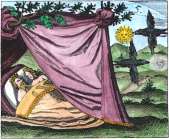
-->
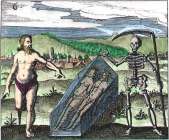
-->
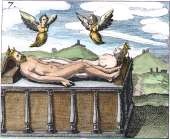
But as the "soul" gradually started to return (which I experienced as the restored libido to actually live and act . . . and not just lie dormant and "slough" or decay or regenerate), I felt very certain that I was a long way from experiencing any kind of "rebirth". Yet, Jung's portrayal of the
Rosarium sequence ends with the "risen" hermaphrodite standing on the moon crescent. He refers to this as the "New Birth" in his essay.

I puzzled over this for years without luck. I felt that I had fallen into some non-existent realm of the individuation process. "Things were happening", but I could no longer coordinate them with the emblems of the
Rosarium that Jung had used to portray his individuation theory. But with my return to Jung last year, I also returned to my interest in alchemy and looked more deeply into Adam McLean's
Alchemy Website. Looking at the
Rosarium emblems portrayed there, I came to realize that there were twice as many as Jung portrayed, and that they are organized into two opera, the second opus reiterating the basic structure of the first . . . but with different symbolic emphases. McLean has a nice little article on the
Rosarium sequence and Jung's truncation of it
here.
This all came as a wonderful revelation to me . . . and I was able to see that I was not at all in "uncharted territory" (a prospect that frightened and frustrated me . . . and which seemed unconscionable, and so I worried that the inflation of the Work had deceived and deluded me). In fact, the emblems of the "second opus" made perfect sense to me. They depict the de-spiritualization that I had been experiencing over the last few years. They also began to lend a certain meaningfulness to my obsession with one particular emblem from this sequence, the Green Lion Devouring the Sun. For reasons I did not at all understand, this emblem (which I must have seen initially in one of Jung's books on alchemy when I was about 18 or 19) had always had a powerful resonance for me. It seemed to be, somehow, my "secret Calling", my personal meaning . . . but I did not know why, or even what it was portraying.
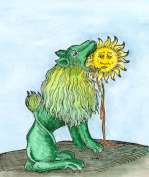
Adam McLean writes:
The being of the alchemist during the hermaphrodite stages has dipped into this well of his being, but has never entirely penetrated deep into its mystery. However, this experience is necessary for the complete inner development of the alchemist, and it is pictured in illustration 18 as the Green Lion devouring the Sun. The sun here represents all that the alchemist has so diligently won for his consciousness, through working this process of inner development. The Green Lion is the devouring, dissolving aspect of the unconsciousness. (The alchemists drew here an analogy with Aqua Regia, the greenish tinged acid that alone could dissolve metallic Gold.)
The alchemist must be prepared to make this sacrifice of his conscious achievements to the dark well of his unconscious being, if he is to further the process of integration, for only in this way can he fully encompass this realm and unite the three streams that pour from the fountain into the vessel of the lower soul (Illustration 1).
I would put a more biological twist on the bolded passage above. The Green Lion devouring the sun is a recognition by the individuant that the Work is guided by instinct and is meant to facilitate instinctuality. The Work is not a personal "attainment", is not "mana". It is the (increasingly) conscious participation in the instinctual process of individuation. The Work aligns the ego-will with the will of the Self, which is a natural will. The Self seeks equilibrium with the environment. Or, in other words, "graceful adaptation". Instead of succumbing to unconsciousness or participation mystique and therefore becoming dependent on the Self, a leech of the Self's libido, the individuated ego seeks to serve as a conduit for the libido of the Self, to help the Self's instinctual, natural, libido find equilibrium with the environment of the organism. The ego (in my hypothesis) evolved as a "rapid adapter" for the complex, information-rich evolutionary niche of human culture. It is an organ of adaptation to a state of environmental flux. It can learn how to adapt without biological mutations by employing abstract, conceptual paradigms.
But the extreme plasticity (or arbitrariness) of the ego allows for what we call (in philosophy) "Free Will" . . . or at least a will "freer" than that of other species who have less cognitive plasticity or adaptability. We do not have to individuate to be human, but individuation allows us to better use this organ of consciousness we evolved to channel instinct into living. And when human instinctuality is dissociated due to the fixation on or over-valuation of human cultural laws and affiliations, the demand for individuation (a radical ego reorganization) increases dramatically.
In tribal cultures, instinctuality is managed ritually. Consciousness (i.e., the consciousness of the individuated ego) is not really necessary as long as the tribe can exist in equilibrium with its environment. But tribal culture, although it may best represent "instinctual humanness" in certain ways, was
not the most adaptable formulation of human society. Therefore, we have very few tribal cultures still in existence . . . and many of these likely do not really function in exactly the same way that prehistoric tribal cultures did. We know, for instance, that the intrusion of modern cultures into tribal cultures tends to work to the distinct detriment of the tribal cultures.
That is, modern culture is more "adaptable" and tends to offer greater survivability to its members. I don't mean to suggest it is in any way "better" than tribal culture . . . I merely mean to suggest a reason why it has become ascendant globally. But modernism tends to dissociate us from our instincts (creating "neuroses"). Individuation (which is maybe a modernization of shamanism) seeks to adapt the individual to modern society . . . not to recreate an isolated pocket of tribalism as an Eden to which the individual can return and in which s/he can hide from modernity.
The individuant must even learn how to adapt the shamanic instinct to the modern . . . and I think this largely involves consciousness of the mana-personality and its "tribe-seeking" impulse. But whether in the shaman or in the individuant, the individuated ego represents a manifestation of the instinctual drive toward "super-adaptivity", which is perhaps the quintessential, biological trait of our humanness. One can become both conscious and instinctual simultaneously. Instinctuality doesn't require unconsciousness due to the super-adaptive organ of the ego.
My current best guess is that the individual (or shaman) is to the prehistoric tribe what the ego is to the brain or to the entirety of the psyche. That is, tribalism doesn't typically require every member to be an individuant in order for the tribe and its members to live in a state of instinctual equilibrium with the environment. But the tribe needs some kind of super-adaptive conduit to help it in times of "strategic breakdown", i.e., when instinctual existence as a simple continuation of the pre-established mode fails to serve the tribe sufficiently. A contagious illness may sweep through, a food or water source may dry up, another tribe may invade or encroach on defined territory, etc. These kinds of events are accredited to the gods, spirits, or ancestors . . . and so the shaman must be called in to "commune with" these gods, spirits, or ancestors and reformulate a rapid strategy adaptation. As long as this rapid adaptation is channeled ritualistically, the shamanic mana (the dangerous disruption of stranger-mana) can be diffused, the spirits can be appeased.
But in modern society, we don't so much live in the tribe as the tribe lives in us. The entire shamanic, super-adaptive ritual has to be constructed and guided internally (most of the time). The shaman is activated as an archetypal force when we need to re-strategize, and is therefore typically projected and/or personified in the psyche (like Jung's Philemon). But as the figure is pursued, it can become a kind of idealized personality that we wish to become (or be seen as). The shaman carries or identifies with this figure and may be able to encourage others to project it upon him or her. But the inflation (and
conflation) occurs when the individual mistakes this archetypal drive of individuation or increased adaptivity for an element of the ego, for an ego-strategy itself. That is, how do I construct a coherent, resilient, nicely-fortified ego? By draping myself in shamanic mana. That ego-strategy is inflated. It seeks to use (misappropriate) the mana-personality for self-defense. This isn't a true or functional adaptation, and (as mentioned previously), one tends to react to this inflation by seeking out others who are willing to see one as the mana-personality incarnate, by seeking out a tribe and its aggrandizing participation mystique. The fact that (when in this state of inflation) we desperately "need" others to confirm it for us should be a distinct warning sign.
The greatest danger for "modern shamans" is succumbing to the inflation in such a way that they do not actually manage to help others adapt to modern society. Instead, they prescribe cultism or Edenism, a retreat away from modern life and toward a tribal structure. This retreat need not be entirely, or even overtly, foolishly or destructive. It is actually likely to provide a great deal of comfort and support to its members. But it is not preparing them in any way to be conscious or to become a better, more responsible, or more ethical citizens for the larger society in which the tribe is merely a tiny droplet.
I don't want to finish with what must seem an utter disparagement of tribalism in modern society. It should be acknowledged that we have a powerful instinct for tribalism . . . much as we have instincts for aggression and empathy. But as with these other instincts, there are adaptive ways to use them in today's world and dysfunctional ways to use them. We can't excise our tribal instincts by act of rational willpower . . . nor should we. Our species' social gravity pulls us naturally into tribal groups. But we have learned that tribal groups are not adaptive in modern society . . . nor are they liable to benefit modern society or address the problems of modernity adaptively.
The conscious navigation of these little social "droplets" and sub-sub-cultures, then, is in no way easy for us. But we can find ways to adapt. Because that is what we do. That is what we are.

