Author Topic: Shamanism, Individuation, and Evolution  (Read 36180 times)

Matt Koeske

  • Management
  • *
  • Posts: 1175
  • Gender: Male
    • Useless Science
Shamanism, Individuation, and Evolution
« on: May 23, 2007, 11:33:47 AM »

The following post is an introduction to this topic.  It discusses how I came to it and why I want to talk about it.  It may seem a bit "beside the point", and for that I apologize.  In the rest of the thread, I hope we will be able to talk more about the subject specifically, i.e., "Shamanism, Individuation, and Evolution".

I recently read J.R. Haule's books in progress, Evolution and Archetype.  I was extremely excited to see that a Jungian had made a serious attempt to bring the ideas coming out of contemporary evolutionary psychology together with Jung's intuitive psychology.  I hoped that this book would represent the scholarly actualization of the foundation that I am basing all of my current thinking on (i.e., that the archetypal, willful unconscious that we perceive as powerfully compelling, mystical, and numinous is founded in biological instincts that have evolved with the purpose of aiding our survival and success in the material world . . . and that, therefore, we have a "rational" way to study these seemingly "irrational" numinous phenomena . . . by understanding how they are intentioned as biological, evolutionary, adaptive processes).

Of course, I've read many of the same source materials that Haule has (relating to evolutionary psychology), so I was well aware that such a scientific, biological foundation existed for archetypal theories . . . but I had always feared that Jungians steered as far away from making this connection as they could manage.  After all, as "rationalism" and science seep in, the mystique tends to be diminished.  And, from what I've seen, the majority of interest in Jungian psychology today is an interest in its mystique or numen.  Jung's ideas represent to many of his followers a way of accessing and celebrating the unconscious.  But it seems to me that only a tiny minority of Jungians truly follow Jung because he introduced a higher level of empirical, rational, logical, maybe even scientific understanding to the psyche (the phenomenological psyche).

But to me, Jung's greatness was not a measure of his mysticism, but his deep dedication to thinking clearly and observing rationally even when faced with the overwhelming numen of the unconscious.  This is the quality that sets Jung apart from many of his more mystical and New Age followers.  He didn't just "get high" off of numinous experience, he made sense of it, brought it into a rich human language . . . a richer, more intelligible, more universal language than religions and mysticisms of the past had offered.

Overall, I found Haule's book very rich in much the same way.  But it ultimately didn't provide a true "coniunctio" between Jungian thinking and evolutionary thinking (not in the way I have been imagining it in what I call the "religion-science coniunctio").  Haule introduces a great deal of scholarship (from other contemporary, scientific fields), and he demonstrates a few ways in which Jung intuited such developments.  But I remained unconvinced that a scholar (or even a serious reader) in those more scientific fields (like neuroscience, anthropology, evolutionary biology, etc.) would become more interested in Jung's thinking after reading Haule's book.  Jung and his thinking are actually quite marginalized . . . and Jung comes off looking mostly obsolete.

I happen to disagree with this effect.  I don't think Jung is obsolete at all.  When I have read evolutionary psychology books, I have been constantly faced with the feeling that the authors would benefit from reading Jung.  Evolutionary psychologists are thinking from basic concrete data "upward".  Jung collected and classified a great deal of "high-level", phenomenological data from psychic experiences and products of human religiosity and artistic expression.  In my opinion the data from both approaches is saying the same thing, and a true coniunctio would meet somewhere in the middle.

Of course, we cannot base biological ideas on a study of psychic phenomena and intuition alone.  That is not what I advocate.  I do advocate the usage of such phenomenological data (much as Jung used it) to draw the eye of the scientific observer to specific areas of research.  Psychic phenomena should not be flatly dismissed.  Such an attitude is fundamentally unscientific.  Psychic data is pertinent . . . if we understand how to valuate and apply it.  These psychic phenomena are like the iron filings adhering in the shape of the magnetic pattern hidden from view.  I firmly believe that these archetypal observations have a meaningful place in scientific research and thinking about human behavior and consciousness.  So much of what makes us human is in what we create, express, or produce.  These creations are not ready-made "truths" . . . but they are data.

I do not think Haule would disagree at all, but this science-religion coniunctio that compels me is not at all his agenda.  And he does have an agenda . . . one that may at times distort the scientific data in what I believe he means to be a "scientific" book.

Haule's agenda is fixed on shamanism and altered states of consciousness.  He wishes to show that the evolution of our consciousness (and our species), especially at its later, proto-human stages, was "urged onward" by "our" experiences with altered states of consciousness.  These altered states were, he suggests, first attained by shamans, who then found ways of leading other members of the tribe through such experiences in ritualistic fashion.  He brings in a bit of neuroscience and talks about how such experience help rewire the brain and promote bi-hemispheric thinking.  He suggests that our ancestors may have even developed technologies, tools, and hunting strategies by drawing "wisdom" from altered states of consciousness and shamanic visions.  In effect, civilization as the result of visionary (rather than practical, or "trial and error") experience.

My gut reaction to this was, "That's bullshit."  I have never been an advocate of peek experiences and altered states of consciousness.  My experiences with such altered states have shown me mostly grandly numinous images that felt profound . . . but had little or no lasting, practical significance or immediate (unprocessed) real-world application.  I have always had to meet, reckon with, analyze, and "cook" these experiences with as much consciousness as I could muster to make use of them.  My belief is that these experience rarely say what they mean in the literal way that we usually use our languages.  Ultimately, we choose what to make of them.  And we can make horrible mistakes in the way we choose.  The altered states don't tell us how to interpret them.  The ego tends to have the final say about meaning, and I have seen more of these altered states and visions co-opted to fit prevailing ego strategies and even self-protective, neurotic delusions than I've seen them used for true adaptation (as they would have to be in order to have derived from an evolutionary process).

I have never seen signs of "higher consciousness" or increased ethicality in people who devote themselves to basking in the numen of the unconscious.  That is, as I have hung around "spiritualistic types" in these Jungian and New Age communities, I have seen no correlation whatsoever between true consciousness (an awareness of how one is composed of affiliations and fictions and has been a kind of ghost writer of these fictions), which tends to lead to increased ethicality and valuation of others . . . and spiritualistic ideas, experiences, or indulgences.  We may surround ourselves in myths, philosophies, occult notions, astrology, shamanism, whatever floats our boats . . . but these trappings do not necessarily mean we are more meaningful, conscious, "in touch with Otherness", "spiritually experienced", or individuated.

I like a lot of people that have many spiritualistic interests, and some of these people are great explorers of consciousness who manage high levels of integrity, credibility, and ethicality.  But their spiritualistic interests are not what has enabled their individuation, no matter how important these things feel to them.  Not that any of us should be begrudged our spiritualistic clothing and hobbies.  But there is a difference between bringing these satellites into one's personal gravity or mythos and hiding a petty, narrow-minded, fearfulness and prejudice behind them.

Still, Haule presents some credible arguments and interesting data regarding his claims of the evolutionary significance of shamanic "supermen and superwomen".  He may not be using these data absolutely scientifically, but there is definitely something there to look into (perhaps beyond what Haule himself concludes).  Despite this, the book (i.e., Haule's attempt to ram his fascination with altered states, shamanism, and New Age spirituality into the armor of scientific literalism or materialism) upset me.

It upset me, because it made me feel that Jungians were beyond reasoning with.  Logical argument and true gnosis (the quest to know what is, not just what something is like or feels like to the ego) are looking to be impossible in the Jungian community.  Every bit of knowledge, scientific, mystical, experiential, what have you, was just an excuse to get a "fix" from the numen.  The numen for this community is not motivational, not adaptive, it is a pipe dream that traps us in our opium dens.  The numen inflates us.  We are coming to it to feel empowered, to float on air, to transcend.

In my opinion, this a corruption of numinous experience.  The numen is not itself the object of true worth.  It is the effect (basically, and I suspect, literally, a chemical effect) of intense valuation that surrounds a "doorway" or the beginning of a potential path or life-strategy pattern recognition.  It helps us know that, should we go that way, should we do such a task, should we actualize and act, we may find the experience deeply meaningful and adaptive.  But the New Age (and this now seems to encompass Jungianism) mindset does not really treat the numen as a road sign.  Instead, it worships the numen itself for its opiate effect . . . and comes back to it again and again like an addict.  The New Ager is merely standing (or perhaps kneeling) at the side of the road, staring in awe at a sign that reads "Meaningful Journey, exit in 80 miles".  The entire idea that one should stop to worship these road signs is oppositional to the purpose of such signs.  I.e., they tell us what is ahead, what could be, what options we might have if we follow this road long enough.  They do not tell us what is, what to do, or who we are.

As a result, such sign/numen-worship becomes commodified (or totemized) by the ego and used as an affiliation indicator, a kind of "gang color" that informs others what tribe one belong to.  Totemization is a kind of fossilization of a numinous symbol or archetype.  But archetypes and symbols themselves are processes meant to encourage movement or transformation.  We have been "misusing" archetypal symbols this way for as long as we have been human, I suspect.  This numen worship is common in tribal societies . . . as is shamanism.  In fact, one gets the impression that Haule advocates a return to tribalism, albeit, not overtly.

This mystique of tribalism is powerful in the New Age and Jungian communities.  As one who has always made a good heretic and is simply rotten at belonging to tribes of any kind, I have noticed and been fascinated by this pull of tribalism in the Jungian communities (all of which I have found estranging in one way or another).  It never would have occurred to me to create or encourage the formation of a tribe . . . and I am highly conscious of keeping Useless Science out of this tribal seduction.  But the fact that so many in our groups are compelled by tribalistic transferences (e.g., participation mystique, Eros worship, "Edenism", "Primalism", shamanism, etc.) leads me to think that this is a very important topic to investigate and discuss (one of the reasons I'm starting this thread).

Haule, I suspect, is not unaware of these danger, this kind of misuse of numinous experiences.  But I find his exuberance in glorifying the attainment of altered states somewhere between reckless and irresponsible.  Irresponsible, because he doesn't adequately frame the shamanic experience of altered states in 1) a sufficiently modern social context, and 2) a careful examination of the inflation or mana-personality issues that are the bulk of such experiences.  It is irresponsible to promote the value of shamanic experiences without talking mostly about the dangers of inflation, without constructing some kind of plan for dealing with the will to power of the mana-personality.

The entire value of shamanic experience is determined by the way one deals with the mana-personality.  That is, simply "having the experience" is not the point at all.  The difficulty and worth of the experience comes in how we make it useful, practical, adaptive.  The inflation (that the experience aggrandizes the individual) is not the "meaning", it is the side-effect.

Inflation is, in my opinion, already the Achilles Heel of the Jungian mindset.  The last thing the Jungian community needs (as it slips deeper into tribal unconsciousness) is for someone to try to use an abundance of scientific data to misdirect Jungians away from actually dealing with the inflation and the painstaking process of individuating.  Jungians are already addicted to the numinous experience.  We have learned how to have an abundance of such experiences without individuating at all.

What I would like to do, therefore, is devote the rest of this thread to talk about what shamans really are, what significance they might have in modern society (as opposed to tribal society), why they experience the inflation, what the inflation means, how we might manage to deal with it adaptively . . . and how all of this might fit into a framework of evolutionary adaptation (i.e., why does our species have "shamanic inclinations").

-Matt
You can always come back, but you can’t come back all the way.

   [Bob Dylan,"Mississippi]

Matt Koeske

  • Management
  • *
  • Posts: 1175
  • Gender: Male
    • Useless Science
Re: Shamanism, Individuation, and Evolution
« Reply #1 on: May 23, 2007, 04:35:43 PM »

I am not an authority on shamanism.  I have never read a book on shamanism, nor have I have I had any first hand experience of practicing shamans.  I have read about shamanism second or third hand (mostly in Jungian books and essays) . . . but I had never been very interested in the subject.  Like many "rationalists", I had generally thought of shamanism as a tribal practice that was dependent upon "transference" (much like psychotherapy) that had no real significance to modern social structures (except, perhaps, reinterpreted as psychotherapy).

Beyond the psychotherapeutic modernization of shamanism, I prejudicially dismissed shamanism in contemporary or more urban contexts as just another form of inflated spiritualizing . . . much like "guruism" and other cults of personality.  But reading Haule's book made me think more openmindedly about shamanism (although, as my post above indicates, it by no means "converted" me to the tribe's dogma).

For instance, it made me look at some of my own experiences and aspirations through a shamanic lens.  I realized more clearly that my foray into the world of poetry was a shamanic endeavor.  I have for years (among my poetry comrades) promoted the role of the poet in society as a shamanic role.  I believed (and probably still do) that the poet is a "go-between" who descends into the unconscious and returns to the world with translations of his or her dreams and visions, tales of his or her experiences of communing "with the gods".  Poetry seemed to me a reasonable way of bringing unconscious content and psychic experiences into the light.  This was the way I practiced the art.

In general, my declarations of poetic shamanism fell on deaf ears in the poetry community.  There is a great fear of poetic "hubris" in today's academic, poetry community.  Poets are supposed to keep a low profile, stay away from visions and romanticisms, and follow the party line and the PoBiz (what we poets call the contemporary system of poet-making and poetry publication) rules of conduct.  Individuality and "communing with one's gods" are intensely frowned upon.  I know this probably seems absurd to a Jungian, non-poet audience . . . but this is merely one discouraging factor of the very sad state American poetry is in today.

As a "poetic shaman", I found that I had no place in the PoBiz tribes that huddle together in academia today.  These tribes could not understand my "shamanic experiences" or the aesthetic philosophy or craft I derived from them.  Additionally, there is no viable "outside" in the poetry world today where such things are valued.  As a "poetic shaman" I was a non-entity.  The people who read poetry today don't read to encounter such things (as I had always read poetry to do).  After struggling with this for years, I eventually accepted that this mindset was beyond my ability to influence it . . . and I moved away from poetic pursuits, returning to my Jungian roots.

But I should say that at no time in my adult practice of the poetic craft, even as a "poetic shaman", did I feel like I was bringing something heroic or healing or even essential to the hypothetical poetry audience.  I never felt "poetry really needs me" or "there's a significant audience in the poetry world just dying to be 'awakened' by my writing" (of course, as a boy I had such romantic fantasies . . . and I believe all young poets do originally, and later come to repress these "inflations" . . . this is a topic I wrote about frequently).  I recognized very early on (as an adult writer) that I was merely trying to valuate the shadow and use my poetry to humanize the aspects of the poetic and individual experience that had been repressed or neglected (and that this was in no way a "salvation" to anyone).  Much of my poetry was a meditation on inflation, especially as it manifests in the puer/senex dichotomy (a fissure created by and expressing inflation).  In essence, I was writing poetically about the fallout of the shamanic experience.  Anyone interested in how I approached the subject can read my book online here: What the Road Can Afford.

It might even be fair to say that I used this book (which took about 8 years to write), to process or alchemize the prima materia of the shamanic inflation or mana-personality that had ravaged me some years before I started writing the poems for this book.  The book was an act of differentiating what was valid and adaptive from what was delusional and self-destructive in the inflation experience.

So, in other words, I do know something else about shamanic experience in a personal, first hand way.  I could speak in great detail about this, but I think it will suffice to generalize for this discussion.  The shaman, as I understand it, is an individual who is in some symbolic manner "dissembled", broken, dismembered, dissolved, swallowed, or killed . . . who manages (of course, with the significant assistance of the unconscious) to reassemble him or herself into a "new body".  The shaman dies and is reborn as something else . . . and that something else is a person imbued with an awakened Otherness, an Otherness for which the shaman's new body becomes the conduit or container.  This Otherness is a connection to the instinctual unconscious, or the Self, in Jungian terms.  It is the Self that helps reassemble the shamanic body . . . and we may even say that it was the Self that dismembered the old body.  In other words, instinct drives this process, a will that is not-ego.

As I understand from what I have read, what I described above is the common factor in the shamanic experience.  I have personally always framed this in the symbolism of alchemy, which describes exactly the same process of dismemberment and reassembly (as a new body that combines the Opposites or integrates the Other in some way).  I came to alchemy, like many, through Jung . . . and, of course, Jung's individuation process is another parallel, another language for the shamanic experience.

The primary difference between individuation and shamanic reassembly is that the individuant (by Jung's prescription) is supposed to "fight off" the inflation in order to stay conscious and partially grounded in the material world, whereas the shaman effectively "becomes" the inflation and uses this "mana" to perform magic acts of healing, prophesy, "spirit-battling", and advice-giving.  My personal take on this is that both approaches to the inflation or "mana-personality" are flawed and ultimately inadequate.

Jung's prescribed "repression" of the inflation merely leads to a puer/senex split where the inflated puer is pushed into the shadow and the senex is aggrandized (but gradually takes on more and more shadow qualities of the puer without fully realizing it).  This, in some ways, is probably a reasonable description of Jung's own complex.  His puer, visionary, transcendent experiences were kept to his private life while publicly he got to "play" doctor and authority on the unconscious.  Perhaps it was his senex side that always insisted (unconvincingly) that he was a scientist.  He managed to keep the puer and senex polarized by force of will.  But the divide broke down as he reached old age and illness, and he began to give more and more "public" time to his puer pursuits of mysticism, spirituality, and paranormal phenomena.  But this "enantiodromia", in my opinion, was not a true coniunctio, but more of an abaissment du niveau mental, to use one of Jung's own favorite phrases.  At the end of his life, Jung merely managed to live out previously repressed content . . . but I do not believe he showed many signs of processing this content.

The problem with Jung's approach to inflation is simply that it does not work . . . and only seems to work to the degree that one can muster voracious willpower, a willpower which is itself partially driven by the inflation of the mana-personality.  The prescription of repression is ultimately a descent into Bad Faith.  But Jung broke significant new ground with the attention he did give to the inflation.  He helped us see 1.) that it exists, 2.) that it is the product of a specific, archetypal, psychological experience . . . an experience that is generally "positive" or adaptive, 3) that the inflation is very powerful, very seductive, and potentially very destructive, 4) what the inflation "looks like" in another person (signs, symptoms, etc.), 5) that the inflation is not indicative of true power, mana, charisma, or divinity/avatarhood (and is thus a kind of negative side-effect), and 6.) that the inflation must be confronted and dealt with in order for individuation to progress adaptively.

To my knowledge, no one else has had as much to say about inflation as Jung.  It generally goes unanalyzed . . . either it is embraced or rejected as evil.  With either approach, the subject itself is clouded in vagueries and abstractions.  We are told to deal with it, but not how to deal with it. 

I believe there are some indications in alchemy that suggest a greater awareness of inflation . . . but I'm not yet sure this understanding was universal in alchemy or that it was truly sufficient.

In tribal shamanism, the inflation is handled much differently.  There seems to be an unconscious acceptance in tribal cultures that have shamans that the shaman's inflation/mana can be useful to the tribe as long as it is ritually controlled.  That is, it is my understanding that shamans frequently live their daily lives outside the tribe, but are called on to conduct rituals, give advice, or heal the sick/deal with evil spirits.  The link between the shaman and the rest of the tribe is, I think, very much like the transference phenomenon in psychotherapy . . . except the  ritual containers for these transferences are quite a bit stronger and more ordered or typical than the containers in psychotherapy.  The entire tribe accepts and encourages the value of these rituals of transference.  "Neurosis" is less an individual issue than a tribal issue.  Neuroses (in the form of evil "spirits") are always in danger of contaminating the entire tribe . . . perhaps because tribes tend to exist in a state of participation mystique, where psychic contents are not seen as personal "possessions", but as tribal contents.  It matters more that the tribe is "sick" or in danger of becoming "sick" than it does that an individual is sick.

The mana-personality of the tribal shaman is typically feared at least as much as honored.  His or her mana is taboo.  The tribe does not look into what it's really all about, but accepts and even totemizes it.  Whatever burden it places on the shaman as an individual is no business of the tribe.  That is something for the shaman to deal with outside the tribe.  This protects the totem of the participation mystique.

Jung doesn't acknowledge this in his essay on the mana-personality (as I discussed here), but he did understand the value of the inflating participation mystique in the analyst's office as transference.  He did not think it was wise or useful to try to dispel the transference when it manifested.  He lectured on this extensively in the fifth Tavistock lecture (published as Analytical Psychology: Its Theory and Practice).  [I don't have the book in front of me at the moment, but . . .] Jung spoke there of the danger of inflation for analysts due to the aggrandized projections made onto them by their patients (who were looking for some form of savior).  He felt this inflation destroyed a good number of analysts who started to believe in these projections (and went off to form their own mana-driven sects) . . . but he cautioned his audience (of analysts, mostly) that it would be counter-productive to the analysis to try to throw off the projections initially.  He felt the psychic contents had to be objectified (or seen as non-ego elements) in order to be dealt with functionally.

I believe this utilization of transference is precisely what is happening in tribal cultures that use shamans.  An the inflation and psychic contents of these shamans are objectified to some degree by the rituals that contain their participation within the tribe.

One of the important questions to ask is this: if inflation is "not real", how do tribal shamans manage to "heal" people or perform "magic"?  Or is this simply bunk?

I don't think this is bunk at all (it may relieve any spiritual-minded readers that are still with me).  No more than transference is bunk.  If anything, the transference (or Eros) of the tribe in participation mystique is substantially stronger than the transference in the analyst's office.  The next questions to ask are 1.) how effective can transference be as a "healing device", and 2.) can this technique be utilized outside the tribe and its participation mystique?

A valid measure of transference and "faith healings" has never been made as far as I know.  We are still polarized (in our culture) in a way that leaves delusion on both ends.  The Western medical establishment is only just beginning to realize that attitude and belief can have a benefit in the healing process . . . but it is still mightily suspicious and generally dismissive of such practices as intentioned alternatives to "conventional medicine".  On the flip side, there are many advocates of alternative medicines and spiritualistic healing methods (many of which have existed since our tribal days).  These advocates (and I suspect there are a very high percentage of these folks in Jungian communities) decry Western medicine (for many very good reasons, in my opinion).  But in this state of polarization, both sides exhibit more belief than knowledge (on the issue of psychosomatic effects and the so-called "psychoid" level of "mind-body unity").

I've seen some research collected by skeptics and rationalists (who find "Eastern" and natural medicines terribly irresponsible if not imbecilic) regarding forms of "faith healing" like laying on of hands, energy and aura healing, "vedic science", etc.  This data shows that such methods have no discernible effect.  Of course, it's only barely worth mentioning, because "true believers" in these methods don't really care about data like this.  From the "opposing tribe" we get many first or second-hand accounts of successful spiritual healings (J.R. Haule is fond of this kind of "data").  But, of course, these observations are never made under real scientific studies.  There are no test criteria, no control groups, no iteration, etc.

I suspect that the statistical data we have on the relationship between belief/faith and healing is as accurate an indicator of the true effectiveness of spiritual healing as any other measure available at this time.  We know that there is definitely some correlation between such faith and healing . . . but it would be irresponsible to think the healing value of faith is "miraculous" or capable of instantly eradicating any illness or infection.

I personally have no idea where to draw the line between what faith/transference can and cannot do . . . nor do I care to posit a guess.  I'll try to remain both open-minded and skeptical on this issue.  What I do feel is worth mentioning, though, is that what both Western medicine and many of these New Age spiritual healing practices have in common is an "understanding" of illness as largely inorganic and alien.  My suspicion is that this is simply "wrong".  Why is healing "good"?  Why is illness "bad"?  Is illness really "other"?  Can or should it be simply removed or eradicated?  The relationship between organism and illness is, I think, much more organic, natural, and complex than either system of healing commonly recognizes.

I don't think the only value associated with illness is in the recovery from it.  Illness puts us in touch with our bodies in ways nothing else can.  When we are sick, we are typically experiencing symptoms which are created by our own bodies.  But the symptom and the illness are not the same thing.

Our bodies decay.  We have lifespans.  Our genes have a very significant effect on our "rates of decay" and our susceptibility to various illnesses and health issues.  Not all illness is "environmental".  Some people who live utterly unhealthy lives live much longer than "health nuts" . . . including people who practice yogic meditations and so forth.  Of course, there is a correlation between longevity and healthy living, but it is not the only factor of importance.  To think that spiritualistic healing can or should cure anyone who "really wants to get better" is ridiculous.  I don't have any personal experience of the Self catering to my egoic fears and desires . . . come what may.

All I know is that the issue of healing is an issue choked with a great deal of projection, shadow, and unconsciousness . . . and that we rarely ask the "right" questions of our encounters with illnesses.  We merely want them to go away, to no longer disrupt our sense of immortality.

So my guess is that when one believes one can heal others shamanically or spiritually, regardless of the kind of participation between healer and patient, regardless of the kind of disease, regardless of the patient's attitude . . . one is in the grip of inflation.  I would also guess that, even within tribes that have a strong participation mystique, the rate of success of shamanic healing is not even remotely as high as the rate of success in Western medicine (for the same illnesses).  I would also posit that diseases that have a more significant psychosomatic component (although it is difficult if not impossible to assess this in many cases) are more treatable with shamanic or spiritualistic methods than diseases that don't.

What we should be very cautious about is romanticizing tribal ideas and behaviors.  It may be perfectly true that our species is a tribal species, that our sociality is fundamentally tribal, but the evolution of human civilization is not merely a mistake.  It is all too easy for us to look at our modern problems and dream of noble savages and shamanic magicians as salvations.  But we should really take a closer look at what was gained before we lament what was lost.  We live longer, healthier, safer lives now (than in our prehistorical, tribal days).  There is more freedom for individuality.  There are more options and outlets and interests to pursue.  As much bloodshed as there is in modern societies today, there is significantly less (percentage-wise) than in tribal societies.  We cooperate better and fight less.  More people have rights.  More otherness is accepted or tolerated.

None of this is to say that Jung's moaning about the evils of rationalism and materialistic science and modernism are without validity.  These are serious issues that we need to find a way to deal with.  I merely remain highly skeptical that the salvation from modernism lies in a return to tribalism.  We should also keep in mind that this return to tribalism is part of the Christian myth (of the Messiah).  It offends and scares many of us today when we see it in our zealous, evangelical neighbors.  This same formulation of tribalism was also a Jewish sectarian obsession around the turn of the Common Era.  The so-called zealots were responsible for driving the Jews into two wars with Rome that culminated in a massive systemic annihilation and dispersement of Jews.  Out of these events and the beliefs that drove them, the Christian mythos was born . . . and the book of Revelations that is still canonized and popular today was probably written by members of one of these zealot sects.

As Christian tribalism joined with the might of Roman imperialism, the Western world was largely destroyed.  Medicine, technology, architecture, art, engineering, philosophy, literature, science . . . all set back a thousand years or more.

As we leap ahead to the 20th century, we can see the participation mystique of tribalism in Nazism, Stalinism, and fascism (among many other destructive cultural movements).  We need to learn something from these events.  Yes, even us mystical, New Age, peace loving types.  We need to see that tribalism allows for a drastic reduction in morality.  It is a cultural system that divides people into Us and Them.  And the Them lose their humanity in the eyes of the Us . . . allowing the Us to mistreat and murder these others with impunity.

All of these things are part of our tribal instincts.  It isn't is just back-to-nature goodness and shamanic magic, ecstatic experiences and animism.  The real problem of the Modern cannot be solved with a retreat into unconsciousness.  We have tried many times and in many ways to accomplish this . . . and these efforts have mostly ended in disaster, atrocity, and holocaust.

I am not at all sure, then, that the shaman can be integrated seamlessly into modern life.  But just as we tend to flock into tribes and tribal affiliations even in modern society, so will shamans continue to emerge.

What then do we do with shamans in the midst of modernity?  If the mana-personality seizes us, the first impulse will be to look for a tribe.  The mana-personality desires to enter into participation mystique with a group . . . but it doesn't typically exhibit consciousness of the problems of tribalism.

I'll end this line of thinking here for now and move on to another angle.

Next up: the shaman as archetypal individual.

You can always come back, but you can’t come back all the way.

   [Bob Dylan,"Mississippi]

Keri

  • Dream Work Vessel
  • *
  • Posts: 407
  • Gender: Female
  • Sedna
Re: Shamanism, Individuation, and Evolution
« Reply #2 on: May 24, 2007, 10:38:44 AM »
Note:  I wrote this reply to your first post last night before seeing your second post.  I don't have time to read the second one right now, so I don't know if mine is relevant anymore, but I wanted to post it anyway. 

Matt,

I haven’t read Haule’s book or even any recent books on evolution theory or anthropology, but a couple of things strike me from your post.  First, I’m wondering if Haule is actually linking tribalism and shamanism and “altered states of consciousness.”  My view of tribalism (derived largely from Daniel Quinn’s Ishmael and The Story of B) is that over the millennia, all creatures have developed (evolved) a way of organizing themselves that is likely to result in the continuance of their species.  Humans, at least early on, seem to have evolved with tribes or small communities being the optimal strategy.  If one assumes that emotions have evolved to help us get by in the world as well, (ie, love perhaps being a useful emotion to keep people together helping each other) it could be suggested that humans are “happy” or feel satisfied when they are in a tribal unit of some kind.  Not that this is the only “right” strategy, but that there may be a strong drive to form tribes, and thus a numinous feeling surrounding that instinct, if I understand you correctly.  We form tribes in all kinds of ways, not simply by “moving away/checking out” to a commune or cult or whatever.  We seem to naturally form cliques, be suspicious of others who are different, identify with others who share similar ideas, etc.  As Quinn states, we (as a culture) are impoverished in many important ways despite our material and intellectual wealth.  Quinn describes the economy of tribalism in terms of support – “give support, get support.”  This is in contrast to our economy – “give products (or the substitute money), get products.”  Perhaps that is why so many people feel powerfully drawn to tribalism now, and that thought allows me have more compassion for those who feel that way.  Tribalism is really about making a living, and the religious aspects are secondary (though, of course, difficult to separate as with most human things).  Most tribal peoples have been animists, but this is not a prerequisite.  However, I agree that to then “worship” tribalism (or more specifically shamanism) as the End rather than the Means is missing the point.  I agree that we are now in a “modern society” and we need to be happy here, not escape to an older time.  But, that may include “tribalism” in a completely new, as yet unknown, manifestation.  In Beyond Civilization, Quinn gives many examples of potential and actual, but non-traditional tribes, including circuses and gangs, as well as small businesses where all involved are 100% invested (financially and otherwise).

Second, the little I have learned of shamans has been that these are people who seek to intercede with the “gods” on behalf of the tribe, and while they help their respective tribal members maneuver the dangerous transition times (puberty for example), often through harrowing rituals, I’ve never had the sense that bringing others into their unique experience of the world was the goal.  I think true shamans use their unique skills (ways of knowing, insight, etc) to help the tribe with practical matters.  I’m sure that there are plenty of shamans who were not quite up to the task, or unable to get their egos out of the way, or otherwise imperfect.  Similarly, I think it’s entirely possible that the people who investigated these tribes or shamans were biased in what they chose to “report” on.  The easiest thing to observe, or most dramatic thing to demonstrate for an outsider, would be a big ritual that would often include an alteration of consciousness experience.  But I distinctly remember a paper I read back in my grad school days about observations of a baboon tribe.  Many initial studies had been done on this particular region’s baboon tribes.  The researchers found that baboons are mostly male-dominated and that the powerful males formed harems and basically got most, if not all, of the mating opportunities.  These researchers were all male.  Later, a female scientist studied the same tribes and found that, in fact, there were particular males who were getting quite a lot of sex outside of the usual framework.  Turns out that these were older males who formed “friendships” with the females, grooming them, watching and protecting their babies, etc.  The females would often sneak off with these males for trysts while the younger, more powerful harem leaders were busy defending their turf.  Which strategy was more successful or more common?  I don’t recall if this was determined from the studies, but it was a powerful lesson for me that what is observed is very dependent on the observer.  Was the female scientist just a better observer, or were there different assumptions or interests within each observer that made them prone to see certain things?

Thirdly, I think that when looking at any religion, there is usually a large gap between the mystics in that religion and the “common person.”  Many mystics, including Christian, Buddhist, Hindu, Islamic, and I suspect animist, have very common numinous experiences.  However, the average practitioner does not frequently understand the subtleties, and thinks that the dogma, or even more subtle, the “religious experience,” is the Thing.  I try (really hard!) not to judge Christianity by the vast majority of people I see these days who call themselves Christian, and I think the same should be done for animism, though there are really very few true animists left to observe.  I personally am not truly animist, but I think it is as viable a strategy as any other for experiencing the mysteries.  But I think I see your second Opus work here, Matt, if I understand you correctly – not seeing the numinous experience as the end, but seeking to reintegrate it and not be inflated by it?  I don’t understand the term “tribalistic transferences” though.

I don’t have a lot of data to support any of this, but it may be interesting or useful to the conversation anyway.  For a really superb treatment of tribalism and animism, and the difficulties our culture faces, try reading Quinn’s work, starting with Ishmael.  They are written as works of fiction, novels, and I think very persuasive.

- Keri

O gather up the brokenness
And bring it to me now . . .

Behold the gates of mercy
In arbitrary space
And none of us deserving
The cruelty or the grace

O solitude of longing
Where love has been confined
Come healing of the body
Come healing of the mind
  - Leonard Cohen, "Come Healing"

Let me be in the service of my Magic, and let my Magic be Good Medicine.  -- Dominique Christina

Matt Koeske

  • Management
  • *
  • Posts: 1175
  • Gender: Male
    • Useless Science
Re: Shamanism, Individuation, and Evolution
« Reply #3 on: May 24, 2007, 03:22:06 PM »

Shaman as Archetypal Individual

How is a shaman different than an individuant?  The experience of dismemberment and reconstruction (rebirth) is really no different.  In both cases, inflation or the mana-personality is activated.  The main difference (if we acknowledge any difference at all) is a matter of the group role played by the individual.  The shaman (as I argued above) is a part of a tribal structure and functions within the tribe in a transference dynamic.  The individuant is, on the other hand, tribeless.  One "individuates" by unraveling the tribal and societal affiliations and constructions of identity.  To the degree that individuation progresses, what is unraveled is replaced with a kind of conscious myth-making, a restructuring of identity rooted in instinctuality.  This "instinctuality" is the relationship to the Self or the valuation of archetypal input from the unconscious.

What then is the individuant's relationship to the tribe or to society?  In tribal cultures there are no individuals in this sense.  The shaman plays the role of "archetypal individual" for the tribe (more on this later) . . . but even the idea of an "archetypal individual" seems to contradict the concept of individuality as we understand it today.  I.e., one cannot be both an archetype and an individual.

I believe the relationship of the individual to the group is a great mystery that remains unsolved even in the modern world.  Socially, human beings exist as complexes of affiliations.  Individuality is not important to the group.  How one behaves in and in relation to the group is important.  One might "individuate" and then say, "Gee whiz, I sure would like to do X, Y, or Z for the group!"  But this doesn't mean the group will accept X, Y, or Z from said individuant.  In fact, as an unraveler of affiliations, the individuant will seem both alien and perhaps even dangerous to those who are still possessed by the tribal mentality.  The individuant become Other to the group.  To the group, the individuant is generally seen as shadow.  The group may even grant the individuant-Other a kind of "shadow-mana" . . . but this tends to create a very dangerous situation for the individuant.

The individuant unwelcomed by the tribe is subject to the projection of the scapegoat archetype.  We can see in this dynamic that the shaman and the scapegoat are merely two sides of the same archetype, but whereas the prior is welcomed, the latter is exiled.  Even in the role of the shaman, the individual is exiled from most of the tribe's activities . . . and only welcomed back for the ritual usefulness of his or her supposed "mana".

This stranger or shadow mana is by no means an unnoticed phenomenon in our culture.  I think specifically of the series of Clint Eastwood westerns where Eastwood plays the character generally referred to as The Man With No Name.  These semi-surreal westerns merely develop the stranger mana that was inherent in older westerns.  I highly recommend Eastwood's High Plains Drifter as a purely archetypal portrayal of the stranger-mana personality (in shadow mode).  The myth of the Old West in America is largely a myth of the stranger-mana-driven individual who is caught between the untamed wilderness and emerging Western civilization.

We also see this in the experience of African-Americans.  Gangsta rap has a special interest in cultivating stranger-mana, albeit in a defensive sort of posturing.  After all, gangs are tribes . . . but they are strange to one another.

A few decades back, what is perhaps the greatest American work about the stranger-mana (and my personal vote for greatest American novel) was penned by Ralph Ellison: Invisible Man.  Invisible Man is not just a book about the Black experience; it's a book about the Black individuant's experience.  The protagonist goes through ritual after ritual of divesting his cultural affiliations and find he ends up becoming increasingly invisible to others . . . until he ends in bitter isolation.  It's a much more honest portrayal of individuation than we get from various New Age mysticisms that promote individuation as enlightenment, empowerment, success, oneness with God and our "fellow man".

But if one actually divests oneself of tribal affiliations, one must face "invisibility" . . . and the projection of stranger-mana from others.  The famous last line of Invisible Man reads,"Who knows but that, on the lower frequencies, I speak for you."  Which seems to suggest that the individual is, in some sense, also an archetype (at least from the tribe's perspective).  And certainly, the stranger is in all of us (or else we would not afford the stranger mana).

If we look back even farther to ancient Greek traditions, we see a different take on the stranger-mana in the celebration of mysterious strangers who represented the gods in disguise and had to be shown hospitality (or else, of course, one courted destruction).  Odysseus is a complex representation of the individual with stranger-mana.  He even begins his ordeal with Poseidon by first tricking Polyphemus with the pseudonym No Man . . . only to later fall victim to hubris and shout out his real name.  We might see this story as an intricate portrayal of the battle the individual wages with both anonymity and inflation.  Even our names, in some sense, belong to the tribe.  To seize them for ourselves can be an inflated act.  That is, it was not at all Odysseus, son of Laertes, who deceived, blinded, and bested the cyclops . . . it was No Man, the stranger, the invisible one.  We cannot take credit for the mana projected onto us without evoking the wrath of the gods.

So Odysseus must suffer and wander for 10 (?) more years as a kind of karmic debt.  When he finally returns to his name/identity in Scherie, island of the Phaeacians, it is with great grief and through the process of story-telling.  Then he realizes that to be Odysseus is not a matter for boasting, but a terrible weight to bear, a oneness with the grief of estrangement, with his "curse".

As the problem of the Stranger archetype is an immense issue for the individuant, s/he is drawn to spend a great deal of time and libido thinking about it.  The individuant must not only form a relationship with her/his strangeness, but also with the tribe or society to which s/he seems invisible or shadowy.  One is largely at the mercy of the tribe for such recognition or re-inclusion.  The individuant also comes to realize that his/her divestment of tribal affiliations is, in the eyes of the tribe, an offense.  It disrupts the participation mystique, and therefore breaks a taboo.

But we are not hermetic creatures.  Participation for our species is an instinct.  We cannot just chop off tribal connection altogether without losing something essential to our existence.  And with the divestment of affiliations and maya, the individuant is in an ideal position to see the real value of community, of connection to others.  Connection (or reconnection) then becomes the goal of the individuant.  We could call this a consciousness of the value of Eros.  But Eros is not valued at the expense of Logos (i.e., the consciousness required to individuate and divest one's tribal affiliations and maya).

It is in this situation that shamanism becomes a problem for the modern individuant.  Shamanism seems to promise the return to the tribe, to Eros, but the shamanic relationship to the tribe is (as previously discussed) a transference or unconscious, projective relationship.  One's individuality, even as shaman, dissolves into the participation mystique.  In that state, the consciousness achieved through individuation is effectively sacrificed.  The individual returns to a state of dependency on/providence from the unconscious.  Or, as Jung would say, the impersonal psychic contents are no longer objectified.

Of course it's a fine line between believing one is identical with the transference mana and recognizing that, although one is not identical with the mana-personality, one is liable to be seen by others (seeking a shaman) as a mana-personality.  One is then in the position of the analyst who has one eye on the analysand, one eye on the the transference, and one eye on the personal, egoic needs and countertransference.  That is, the individual must be able to see her or himself as other than the transference and countertransference.  The transference/countertransference is a theater, a stage, and the analyst is playing a role while on the stage, but divests the role off the stage.

The theater itself must be flexible, adaptable, not fixed.  The theater has to adapt to the projections/transference of the analysand.  When we fall into the trap of directing the theater to suit ourselves (self-aggrandizement), we succumb to the inflation of the mana-personality.  But, in my experience, this is not something that can be kept in order by force of will alone.  That is, when on the stage, we are the character we play.  It is not a puppet show where the puppeteer is always separate from the puppet, but concealed from the audience.  People (in the position of the analysand in this model) cannot be manipulated into some form of healing or transformation via sleight of hand.  They must be participated with.

. . .

This is all a rather circuitous way of getting at the subject of the title I started this post off with (Shaman as Archetypal Individual).  After starting this post yesterday, I left off puzzling over the evolutionary significance of the individuant (Could there be any?  Do we need to be conscious in order to be human?  Etc.).  I have been running this mystery through my mind non-stop ever since.  I am not yet satisfied that I have "solved" it.  But I will relate my line of thinking so far.

First, I struggled to figure out which point of entry into this mystery would bear the most fruit.  I eventually decided to step back from evolutionary ideas and scientific data and draw from my own personal experience.  In my experience (and this accords with Jung's thinking), the individuation process is guided by instinctual, unconscious forces.  Although it began for me with a period of "spiritualization", a recognition that there was a Self, and that it was intelligent, willful, and essentially the "true master" of my personality.  This period of my life was filled with dreams, visions, and "spiritual experiences" of a symbolic nature.  I learned to value these imagistic, symbolic expressions and understand that the psyche, though immaterial, was "real".  The psyche is what we interact with, how we perceive everything both within and without. 

Basically, with this psychologization or spiritualization, I came to recognize what Jungians like James Hillman and Wolfgang Giegerich champion: a valuation of psyche (or spirit) as separate from matter.  In more alchemical language, the "extraction of spirit from matter".

But in the last few years of my life, this spiritualization has been reabsorbed increasingly into the unconscious.  A "rationalistic instinct" (something like Jung's sensation function, but buoyed by the archetypal unconscious) started to emerge, and I became less concerned with what things are like or feel like and more concerned with what they are essentially.  I recognized that many of my spiritualistic ideas were filled with poetic excess, an excess that was designed to serve my ego.  I began to move away from my more Jungian, spiritual thinking and toward rationalism, science, evolutionary biology, atheism, and ethical politics ("secular humanism").

At some point in this process, I reconnected with the Jungian community and started re-reading some of Jung's writing.  One of the writings I re-read was "Psychology of the Transference", Jung's essay that originally introduced me to the alchemical emblem series of the Rosarium Philosophorum . . . which had always been extremely meaningful and orienting for me.  I had always felt that my personal individuation experience precisely paralleled the emblematic sequence of the Rosarium.  But . . . I had gravitated away from Jung and this Rosarium sequence during my identification with the Purification stage:


The Coniunctio and Putrefactio/Nigredo (and the "flight of the soul") were very easily identifiable as they have their own unique and powerful emotions.  Just as the hermaphroditic body of the conjoined Opposites is still and dormant, so one (experiencing these stages) is stilled, fixed, pinned down while an organic process works on one.  Libido doesn't flow productively into the world.  We become mere observers of our elemental restructuring.

Coniunctio --> Putrefactio --> Flight of the Soul
--> -->

Mylius version:
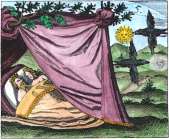
--> --> 
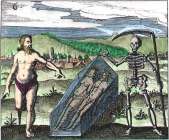
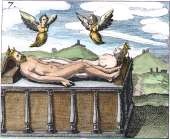
But as the "soul" gradually started to return (which I experienced as the restored libido to actually live and act . . . and not just lie dormant and "slough" or decay or regenerate), I felt very certain that I was a long way from experiencing any kind of "rebirth".  Yet, Jung's portrayal of the Rosarium sequence ends with the "risen" hermaphrodite standing on the moon crescent.  He refers to this as the "New Birth" in his essay.


I puzzled over this for years without luck.  I felt that I had fallen into some non-existent realm of the individuation process.  "Things were happening", but I could no longer coordinate them with the emblems of the Rosarium that Jung had used to portray his individuation theory.  But with my return to Jung last year, I also returned to my interest in alchemy and looked more deeply into Adam McLean's Alchemy Website.  Looking at the Rosarium emblems portrayed there, I came to realize that there were twice as many as Jung portrayed, and that they are organized into two opera, the second opus reiterating the basic structure of the first . . . but with different symbolic emphases.  McLean has a nice little article on the Rosarium sequence and Jung's truncation of it here.

This all came as a wonderful revelation to me . . . and I was able to see that I was not at all in "uncharted territory" (a prospect that frightened and frustrated me . . . and which seemed unconscionable, and so I worried that the inflation of the Work had deceived and deluded me).  In fact, the emblems of the "second opus" made perfect sense to me.  They depict the de-spiritualization that I had been experiencing over the last few years.  They also began to lend a certain meaningfulness to my obsession with one particular emblem from this sequence, the Green Lion Devouring the Sun.  For reasons I did not at all understand, this emblem (which I must have seen initially in one of Jung's books on alchemy when I was about 18 or 19) had always had a powerful resonance for me.  It seemed to be, somehow, my "secret Calling", my personal meaning . . . but I did not know why, or even what it was portraying.
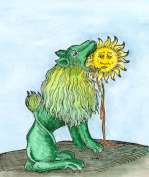


Adam McLean writes:
Quote
The being of the alchemist during the hermaphrodite stages has dipped into this well of his being, but has never entirely penetrated deep into its mystery. However, this experience is necessary for the complete inner development of the alchemist, and it is pictured in illustration 18 as the Green Lion devouring the Sun. The sun here represents all that the alchemist has so diligently won for his consciousness, through working this process of inner development. The Green Lion is the devouring, dissolving aspect of the unconsciousness. (The alchemists drew here an analogy with Aqua Regia, the greenish tinged acid that alone could dissolve metallic Gold.)

The alchemist must be prepared to make this sacrifice of his conscious achievements to the dark well of his unconscious being, if he is to further the process of integration, for only in this way can he fully encompass this realm and unite the three streams that pour from the fountain into the vessel of the lower soul (Illustration 1).

I would put a more biological twist on the bolded passage above.  The Green Lion devouring the sun is a recognition by the individuant that the Work is guided by instinct and is meant to facilitate instinctuality.  The Work is not a personal "attainment", is not "mana".  It is the (increasingly) conscious participation in the instinctual process of individuation.  The Work aligns the ego-will with the will of the Self, which is a natural will.  The Self seeks equilibrium with the environment.  Or, in other words, "graceful adaptation".  Instead of succumbing to unconsciousness or participation mystique and therefore becoming dependent on the Self, a leech of the Self's libido, the individuated ego seeks to serve as a conduit for the libido of the Self, to help the Self's instinctual, natural, libido find equilibrium with the environment of the organism.  The ego (in my hypothesis) evolved as a "rapid adapter" for the complex, information-rich evolutionary niche of human culture.  It is an organ of adaptation to a state of environmental flux.  It can learn how to adapt without biological mutations by employing abstract, conceptual paradigms.

But the extreme plasticity (or arbitrariness) of the ego allows for what we call (in philosophy) "Free Will" . . . or at least a will "freer" than that of other species who have less cognitive plasticity or adaptability.  We do not have to individuate to be human, but individuation allows us to better use this organ of consciousness we evolved to channel instinct into living.  And when human instinctuality is dissociated due to the fixation on or over-valuation of human cultural laws and affiliations, the demand for individuation (a radical ego reorganization) increases dramatically.

In tribal cultures, instinctuality is managed ritually.  Consciousness (i.e., the consciousness of the individuated ego) is not really necessary as long as the tribe can exist in equilibrium with its environment.  But tribal culture, although it may best represent "instinctual humanness" in certain ways, was not the most adaptable formulation of human society.  Therefore, we have very few tribal cultures still in existence . . . and many of these likely do not really function in exactly the same way that prehistoric tribal cultures did.  We know, for instance, that the intrusion of modern cultures into tribal cultures tends to work to the distinct detriment of the tribal cultures.

That is, modern culture is more "adaptable" and tends to offer greater survivability to its members.  I don't mean to suggest it is in any way "better" than tribal culture . . . I merely mean to suggest a reason why it has become ascendant globally.  But modernism tends to dissociate us from our instincts (creating "neuroses").  Individuation (which is maybe a modernization of shamanism) seeks to adapt the individual to modern society . . . not to recreate an isolated pocket of tribalism as an Eden to which the individual can return and in which s/he can hide from modernity.

The individuant must even learn how to adapt the shamanic instinct to the modern . . . and I think this largely involves consciousness of the mana-personality and its "tribe-seeking" impulse.  But whether in the shaman or in the individuant, the individuated ego represents a manifestation of the instinctual drive toward "super-adaptivity", which is perhaps the quintessential, biological trait of our humanness.  One can become both conscious and instinctual simultaneously.  Instinctuality doesn't require unconsciousness due to the super-adaptive organ of the ego.

My current best guess is that the individual (or shaman) is to the prehistoric tribe what the ego is to the brain or to the entirety of the psyche.  That is, tribalism doesn't typically require every member to be an individuant in order for the tribe and its members to live in a state of instinctual equilibrium with the environment.  But the tribe needs some kind of super-adaptive conduit to help it in times of "strategic breakdown", i.e., when instinctual existence as a simple continuation of the pre-established mode fails to serve the tribe sufficiently.  A contagious illness may sweep through, a food or water source may dry up, another tribe may invade or encroach on defined territory, etc.  These kinds of events are accredited to the gods, spirits, or ancestors . . . and so the shaman must be called in to "commune with" these gods, spirits, or ancestors and reformulate a rapid strategy adaptation.  As long as this rapid adaptation is channeled ritualistically, the shamanic mana (the dangerous disruption of stranger-mana) can be diffused, the spirits can be appeased.

But in modern society, we don't so much live in the tribe as the tribe lives in us.  The entire shamanic, super-adaptive ritual has to be constructed and guided internally (most of the time).  The shaman is activated as an archetypal force when we need to re-strategize, and is therefore typically projected and/or personified in the psyche (like Jung's Philemon).  But as the figure is pursued, it can become a kind of idealized personality that we wish to become (or be seen as).  The shaman carries or identifies with this figure and may be able to encourage others to project it upon him or her.  But the inflation (and conflation) occurs when the individual mistakes this archetypal drive of individuation or increased adaptivity for an element of the ego, for an ego-strategy itself.  That is, how do I construct a coherent, resilient, nicely-fortified ego?  By draping myself in shamanic mana.  That ego-strategy is inflated.  It seeks to use (misappropriate) the mana-personality for self-defense.  This isn't a true or functional adaptation, and (as mentioned previously), one tends to react to this inflation by seeking out others who are willing to see one as the mana-personality incarnate, by seeking out a tribe and its aggrandizing participation mystique.  The fact that (when in this state of inflation) we desperately "need" others to confirm it for us should be a distinct warning sign.

The greatest danger for "modern shamans" is succumbing to the inflation in such a way that they do not actually manage to help others adapt to modern society.  Instead, they prescribe cultism or Edenism, a retreat away from modern life and toward a tribal structure.  This retreat need not be entirely, or even overtly, foolishly or destructive.  It is actually likely to provide a great deal of comfort and support to its members.  But it is not preparing them in any way to be conscious or to become a better, more responsible, or more ethical citizens for the larger society in which the tribe is merely a tiny droplet.

I don't want to finish with what must seem an utter disparagement of tribalism in modern society.  It should be acknowledged that we have a powerful instinct for tribalism . . . much as we have instincts for aggression and empathy.  But as with these other instincts, there are adaptive ways to use them in today's world and dysfunctional ways to use them.  We can't excise our tribal instincts by act of rational willpower . . . nor should we.  Our species' social gravity pulls us naturally into tribal groups.  But we have learned that tribal groups are not adaptive in modern society . . . nor are they liable to benefit modern society or address the problems of modernity adaptively.

The conscious navigation of these little social "droplets" and sub-sub-cultures, then, is in no way easy for us.  But we can find ways to adapt.  Because that is what we do.  That is what we are.


You can always come back, but you can’t come back all the way.

   [Bob Dylan,"Mississippi]

Maria

  • Dream Work Vessel
  • *
  • Posts: 70
  • Gender: Female
Re: Shamanism, Individuation, and Evolution
« Reply #4 on: May 25, 2007, 02:25:43 PM »
(Dear Matt and Keri,

Matt:
Quote
The primary difference between individuation and shamanic reassembly is that the individuant (by Jung's prescription) is supposed to "fight off" the inflation in order to stay conscious and partially grounded in the material world, whereas the shaman effectively "becomes" the inflation and uses this "mana" to perform magic acts of healing, prophesy, "spirit-battling", and advice-giving.  My personal take on this is that both approaches to the inflation or "mana-personality" are flawed and ultimately inadequate.

As I understand it, the shaman accepts the role of the vessel. He does not use his own power to heal, for example, but he invites the Other (the Great Spirit, etc) to act through him. The danger of being a shaman is that a vessel is a vessel, and it is not necessarily the Invited that enters... I see the shamanic journey as a metaphoric expression of what enters the shaman, instead of him actually becoming an animal or visiting the land of the dead, these contents enter him.

And about "tribes"... yes, our society changed a lot, and a lot of these changes are positive. What did not change, however, is that most people are not willing to start their journey. Not that they do not have the means, the capacity or whatever it needs, they simply do not want to. They want to feel that they can get in touch with the Other, they do want to know, or at least to hope that there is something more than what they let themselves confront with, they want to be touched by the Other, but not live with It. And in a way, they are right. I don't think that one's life can only be meaningful if they are living with the Other. But it cannot be meaningful without now and then getting in touch with this Other, either.

Matt:
Quote
I believe the relationship of the individual to the group is a great mystery that remains unsolved even in the modern world.  Socially, human beings exist as complexes of affiliations.  Individuality is not important to the group.  How one behaves in and in relation to the group is important.  One might "individuate" and then say, "Gee whiz, I sure would like to do X, Y, or Z for the group!"  But this doesn't mean the group will accept X, Y, or Z from said individuant.  In fact, as an unraveler of affiliations, the individuant will seem both alien and perhaps even dangerous to those who are still possessed by the tribal mentality.  The individuant become Other to the group.  To the group, the individuant is generally seen as shadow.  The group may even grant the individuant-Other a kind of "shadow-mana" . . . but this tends to create a very dangerous situation for the individuant.

This greatly depends on the group. Of course the larger the community is, the more one's individuality (not to mention individuation) becomes a private affair, which is either dangerous, or simply indecent to talk about, or irrelevant at best. But how do we define a group? For example, this forum is also a group, and individuation, our own, and each other's, is a central issue here. If somebody turned up with a collection of cliches that have nothing to do with their personal experiences, I guess we would be quite pissed off.

Participation mystique is definitely true for certain groups, but if we say that this is something a group cannot be called a group without, then we are living in a groupless society, except for some sects. I had this experience when I moved from a small town to a city, and then to the capital of my country, that groups, as I define them, simply do not exist. What we are living in could be defined a bit like how Sandel describes the "procedural republic". It does not matter what your values are as long as you keep yourself to the norms, which are more and more about behaviour, not attitude or beliefs. It seems there are more and more only "formal" groups, especially if you are over your university years. There are the people at your workplace, the people living in your close neighbourhood, perhaps some close relatives (if you are lucky, they are more than formal) and perhaps you have some friends. The latter is already outdated. Most people don't have friends. They have relationship capital... people are not making friends or forming groups, they are "networking".

Most of what we know about shamanism is really about how shamanism was like in prehistoric times or in societies that are untouched or trying to fight against modernity. We don't have much knowledge about how shamanism exists and functions in modern society. But Hungary, for instance, had four so-called shaman kings (between the 11th and 16th centuries AD), who, together with being Christian, were shamans as well, or, as Hungarians call shamans: táltos. They even made laws agains paganism, as they believed it could have endangered a land in the midst of Christian Europe.

But, for example, in Hungary the mother of Jesus has always been called Virgin Mary and never Saint Mary. Her title is "the Happy Woman", which is a name of old shamanistic origin. And especiall in very old churches, Jesus is often depicted as standing close to, or sitting on top of the traditional (shamanistic) tree of life. Even in 1958, in the midst of socialism, a Hungarian anthropologist (Vilmos Dioszegi) published a book that had interviews with a few practicing shamans.

So, perhaps it is not surprizing that for me, a shaman (táltos) is not attached to, neither bound by a certain belief system. A shaman is somebody who goes through a strange (I wonder whether to call it mystical) experience, and then not only returns, but also decides to become a vessel, a mediator of the Other (s)he meets.  A shaman is a human who builds her house in the in-between. She experiences both the world she shares with others, and the one where most people refuse to enter, and she does not choose. She does not separate but brings together. One world is for the sake of the other, and all the worlds are for the sake of Life.

In prehistoric times, the participation mystique was a very important factor in the survival of humans. Today, we need something else. But at all times we must remember that we have something in common, which is not merely "procedural". It is more than our right to vote or the right for education, etc. And to make people understand this, re-discover this, is I think very important. And my bet is that it must be somewhere between participation mistique and mere formality...

just musing...

love,

Maria)
"Thou speak'st aright;
I am that merry wanderer of the night."

(Puck)

Matt Koeske

  • Management
  • *
  • Posts: 1175
  • Gender: Male
    • Useless Science
Re: Shamanism, Individuation, and Evolution
« Reply #5 on: May 25, 2007, 02:40:56 PM »
 
I haven’t read Haule’s book or even any recent books on evolution theory or anthropology, but a couple of things strike me from your post.  First, I’m wondering if Haule is actually linking tribalism and shamanism and “altered states of consciousness.”  My view of tribalism (derived largely from Daniel Quinn’s Ishmael and The Story of B) is that over the millennia, all creatures have developed (evolved) a way of organizing themselves that is likely to result in the continuance of their species.  Humans, at least early on, seem to have evolved with tribes or small communities being the optimal strategy.  If one assumes that emotions have evolved to help us get by in the world as well, (ie, love perhaps being a useful emotion to keep people together helping each other) it could be suggested that humans are “happy” or feel satisfied when they are in a tribal unit of some kind.  Not that this is the only “right” strategy, but that there may be a strong drive to form tribes, and thus a numinous feeling surrounding that instinct, if I understand you correctly.  We form tribes in all kinds of ways, not simply by “moving away/checking out” to a commune or cult or whatever.  We seem to naturally form cliques, be suspicious of others who are different, identify with others who share similar ideas, etc.  As Quinn states, we (as a culture) are impoverished in many important ways despite our material and intellectual wealth.  Quinn describes the economy of tribalism in terms of support – “give support, get support.”  This is in contrast to our economy – “give products (or the substitute money), get products.”  Perhaps that is why so many people feel powerfully drawn to tribalism now, and that thought allows me have more compassion for those who feel that way.  Tribalism is really about making a living, and the religious aspects are secondary (though, of course, difficult to separate as with most human things).

Hi Keri,

My last post above (third installment on this topic) addresses a lot of what you bring up here, I think.  Very synchronous (as I was in the middle of writing it when you posted . . . although I finished before I read your post)  (-)dance(-) !

I entirely agree with what you are saying here.  It is not my intention to denigrate tribalism in either its original or its modern formulations.  As tribalism is the essence of our archetype for sociality, it is bound to compel us in one way or another.  The Jungian and New Age communities are very interested in tribalism (although they don't always realize it is tribalism they seek).  Tribal structures promote numinous experience, because they activate archetypal participation.

The problem as I see it is that romantic tribalism in these communities tends to defeat two important potentials from developing: 1) individuation, and 2) "scientific progress" or the improvement of our knowledge.  The two are actually related in the sense that both are measures of innovation, adaptivity, ability to change.  The real flaw of tribalism (in spite of its benefits) is that it doesn't adapt well to otherness and change.  This stagnation is pretty easy to see in Jungian psychology today.

My opinion is that we can take two basic approaches to Jungian thinking.  We can come to it or adopt it as an attempt to make ourselves feel enriched, more meaningful, healed, etc.  In this sense, it is a "natural resource" . . . much like the collective unconscious itself.  But I worry that we have come to a point at which we cannot just go on pumping this resource out of the ground mindlessly.  It is not an endlessly renewable resource.

The other approach then is to find a way to renew it, to keep it viable.

Like most people drawn to Jungian psychology, I came originally for healing, for a language which could make sense of my existential predicament and my Wound and give me a way to move toward personal equilibrium.  I found it extremely useful for this.  Jung's is a splendid practical science.  I drank at the well and I went away (eventually) feeling greatly restored and enriched.

Then I came back to the Jungian community last year.  Well, I had never been a part of the Jungian community, so I didn't actually "come back".  But I came to it looking for a tribe.  Jungian individuation was enriching, yes . . . but it made for a high degree of isolation in the non-Jungian world.  But when I found my "long lost tribe", I was shocked to find it petrified and sterile.  It seemed to me that most people in the tribe had not used Jung's method practically as I had.  Most had merely adopted the language as an intellectual hobby.  The minority of "practitioners" had mostly bogged down in the various pitfalls of individuation . . . perhaps because Jung never made a very coherent map of it for others.  The individuant can use Jung as a source, but must radically redraw the map to make it personally useful.

In a relatively short period of time, I came to see that I was just as alien in the Jungian community (whose "religion" I shared) as I was outside it.  Perhaps I was even lonelier within, because my strangeness was constantly rubbed in my face.  When I wrote of the "stranger-mana" in the above post, I was writing about something I have a great deal of first hand experience with.  I have no experience as a "healer" (thus my equivocation on that issue as it relates to shamanism) . . . but I have always made a wonderful stranger.

After I got myself excommunicated from the Jungian tribe, I had some serious reckoning to do.  On one hand, I knew this was (or represented) my tribe.  On the other hand, they didn't want me to even look at their territory let alone powwow with them.  But I decided that I had an obligation to give back to the Jungian community for all it had given to me.  If this was an unwanted gift, so be it.  Like any stranger, shaman, or individual, I could not practice my individuality inside the tribe.  I could only live on the outskirts.  Useless Science, then, is the outskirts.

It was important for me to put this site together, no just for the benefit of my co-founders (who wanted a dream work forum), but because it gives me a healthy home to practice my craft, my writing.  If I tried to exist (as myself) inside the tribe that excommunicated me (or inside one of the other Jungian tribes), I would be forced into the shaman/scapegoat role.  I represent too much stranger-mana, because my approach to the most precious Jungian ideas is too compensatory and critical.  Also, I am pretty conscious of the mana-personality and have a lot of experience battling with it.  Therefore, I am disinclined to play that up in tribal relations . . . and that leaves me with my old friend, the scapegoat.  But even I can bask in self-destruction only so long before needing some freedom and open space.

At Useless Science, I have open space.  My co-founders treat me humanly, as neither a shaman nor a scapegoat.  Other members come and go as they please.  I guess my deepest personal desire is for others to pass through and find the project I'm working on interesting in one way or another . . . so that they either chip in or critique it.  I want the ideas I am working on to be "objectified" in the Jungian sense.  They are more A work than my work.  I am looking for ways to re-strategize Jungian thinking.  I throw out what I know on the table.  I lay down my hand.  I hope others will feel they can do the same.

The way I see it, Jungian tribalism or participation mystique tends to cluster around Jung the personage.  Jungianism is a cult of personality.  But to the degree that it is such a cult, it is, and cannot be, a science.  A science is interested in investigating and understanding things.  Jung was a scientist in this sense.  But Jungianism has become an experience and not a science.  When I see this, I feel a great loss . . . because I think Jungian thinking makes for a lovely science.  Yes, it needs to keep adapting and responding to new data (which it hasn't), but it is useful.  I think it would be a shame if it was turned into an occult, tribal religion.

Now, of course, I don't expect to be able to do much about the tribalization of Jungianism.  Tribes have various ways of credentialing, and I have no such formal credentials.  I have only my experiences and my thoughts.  I am truly the Man With No Name in the Jungian world.  But I believe the project I am working on (the "religion-science coniunctio" as I like to call it) is a "Good Work".  If it falters, it is my own egoistic flaws jamming up the gears.  But to the degree that I can manage to keep my ego at bay and work in Good Faith, there may be something of value to be produced.  Still, it's an uphill battle, because not only am I a stranger, I am also lazy, contrary, and severely lacking the kind of intellectual brilliance and diverse knowledge of a person like Jung himself.  I am, in fact, a poet.  And a failed poet, at that.

What this of course means is that Useless Science is (for me) the quintessential Fool's Errand (-)smgfool(-)!  But what the hell.  I have come to believe in Fools over the years.  The Fool has been kind to me . . . and I can't resist his smirk or his enthusiasm for quests.  I could do many worse things with my time (and frequently do!).


Most tribal peoples have been animists, but this is not a prerequisite.  However, I agree that to then “worship” tribalism (or more specifically shamanism) as the End rather than the Means is missing the point.  I agree that we are now in a “modern society” and we need to be happy here, not escape to an older time.  But, that may include “tribalism” in a completely new, as yet unknown, manifestation.

As far as I'm concerned, tribalism is inherently fine.  If it works, there is no reason to change it.  If people can exist happily and harmoniously while being unconscious, this doesn't make them bad or less valuable people.  It's great to have tribal comforts, friends, fellow believers.  People should not be compelled to individuate by other people.  It is only necessary when radical adaptation is required . . . and is in no way the measure of an individual's worth.  As one who belongs to no tribes (and seems to have a fundamental inability to), I know all too well how compelling such affiliation is.  It is hard not to be envious.  But I can't seem to manage to sacrifice my consciousness for membership.

But when I see tribalism that is not fine, that is non-adaptive or delusional or actually destructive, my tolerance for tribalism dissipates.  It is a part of our contemporary ideal of segregationist "multiculturalism" that all tribes should be left alone to practice their respective versions of bliss.  Regrettably, this is not at all what tribes typically do.  Tribes fight with other tribes.  That is the nature of tribal morality and tribal identity.  When they aren't actively fighting other tribes, they are excluding Others.  Even as our species radically "globalizes", we are splintering into more and more sects and factions.  I fear that this is not an adaptive strategy.  This is probably the best way to form numerous little subjugated fiefdoms around a few mammoth power structures.  Today, as power coagulates around fewer and fewer centers, we develop more and more tribes.  We've been through this historically.  It's a regression.  It makes for a lot of bloodshed and oppression.

Power likes tribal splintering, because tribes are too small to be able to resist power.  Our tribalism, which is (in my opinion) often pursued for egoic survival reasons (self-protection, comfort, self-aggrandizement, avoidance of conflict, participation mystique, etc.), is (among other things), a refusal to answer the call of power, of large-scale power.  In tribes, we feel safe and distanced from the demands on modern citizens, the demands on socially or politically active citizens.  We do not have to look at larger society if we hide in our tribes.  Modern power realizes this, also, and does whatever it can to encourage the disenfranchisement that splinters people into tribes (and dissolves their power).

Retreat into tribalism is definitely tempting, but is it responsible?  Will this behavior work as a long term-strategy?  I personally doubt it will.  It is non-adaptive in today's world.  We might choose tribalism because it makes us feel better . . . but this "bliss" is a short-term strategy.  I suspect tribal cultures have been mostly eradicated because they represent too short-term a strategy.  Yes, it's nice to "live life in the moment" . . . but this can be a kind of over-attachment to the teat of providence.  A hiding of one's head in the sand.  We are the species that can formulate long-term strategies.  This was what we did to empower ourselves on this planet.  We can look ahead abstractly or imaginatively and plan . . . and this has proven socially adaptive.

It's so hard for us to see this, because long-term planning is (although possible) a kind of contra naturum thinking for our species.  But I believe we must learn or force ourselves to do this in order to survive.  What the people who have achieved power throughout history have found is that more strategic (often longer-term) thinking can provide them with survival advantages.  What we see today with corporate, global  power are often tribes that have longer-term strategies.  They might be selfish, cruel, and inhuman strategies, but they are more effective at protecting and empowering those who employ them.

People (such as the many New Agers) who flock to short-term tribal strategies simply stand no chance against the pursuit of power, wealth, and resources of these longer-term strategists.  If we choose to live in a different world than those who want to control it for their own (elite, not communal) benefit, we will eventually lose the world altogether.  At some point, I feel, we have to stop "following our bliss" and start trying to do what's ethical.

Second, the little I have learned of shamans has been that these are people who seek to intercede with the “gods” on behalf of the tribe, and while they help their respective tribal members maneuver the dangerous transition times (puberty for example), often through harrowing rituals, I’ve never had the sense that bringing others into their unique experience of the world was the goal.  I think true shamans use their unique skills (ways of knowing, insight, etc) to help the tribe with practical matters.

My guess is that the problem with dangerous inflation is greater with modern shamans, shamans who try to exist in the modern world.  But the lust for conversion is not strange to us.  It is the Christian way, for instance.  Christian televangelists are like huge-scale shamans trying to build up tribes of millions (and succeeding).  There are a lot of right-wing political shamans like the pontiffs on Fox News, for instance.  The shamanic personality or mana-personality doesn't necessarily mean one has spiritual validity or humanistic ethics.  Hitler was a shaman in this megalomaniacal, horrific vein.  Stalin.  Mussolini, etc., etc.

Thirdly, I think that when looking at any religion, there is usually a large gap between the mystics in that religion and the “common person.”  Many mystics, including Christian, Buddhist, Hindu, Islamic, and I suspect animist, have very common numinous experiences.  However, the average practitioner does not frequently understand the subtleties, and thinks that the dogma, or even more subtle, the “religious experience,” is the Thing.  I try (really hard!) not to judge Christianity by the vast majority of people I see these days who call themselves Christian, and I think the same should be done for animism, though there are really very few true animists left to observe.  I personally am not truly animist, but I think it is as viable a strategy as any other for experiencing the mysteries.

I think any of these faiths or philosophies have to be assessed from outside the tribe.  But that is becoming "sinful" thanks to our tribal splintering and sense of political correctness.  Tribes are not inherently good or bad.  They are what they produce.  If a tribal belief or practice is harming another group of people, it can't be ideologically sanctified and protected.  If it causes harm, it has to be held up to a higher standard.  That's what humanistic morality is all about, I think.  It isn't the tribe or its dogma that must be protected at all costs, it's the individual.  Across all tribes, the individuals are of equal worth.  It is not just that actions and beliefs should be "judged" on an individual basis, but tolerance is something we have to grant to individuals . . . more so than we do to belief systems or groups or institutions or affiliations.

In my opinion, this is a major social-evolutionary advance from "tribal morality" (us vs. them).  Which is why Jung's (and the Jungians') blanket dismissal of modernism and "scientific rationalism" is flawed solution.  The tribe of the rational may be flawed (in the same way any tribe tends to be), but Enlightenment rationalism also (and more importantly, I feel) brought us a better understanding of humanistic morality, the equal valuation of all individuals.  That is the rationalism that cuts through creeds and affiliations and sees only the value of life and being.  Tribes do not offer that kind of morality.

But I think I see your second Opus work here, Matt, if I understand you correctly – not seeing the numinous experience as the end, but seeking to reintegrate it and not be inflated by it?  I don’t understand the term “tribalistic transferences” though.

By "tribalistic transferences" I merely mean unconscious interrelation in groups, or participation mystique.  Without consciousness, there is no sense of responsibility or ethics (at least not for "Others", those outside the tribe).

As for numinous experience, I think it generally only tells us that something exists that we need to pay attention to.  It doesn't tell us what a thing really is or how we need to relate to it.  It intoxicates . . . and that can feel great, but the hard work is in making something practical out of the numinous experience.  And in seeing what lies beyond it.  Numen is not God.  We don't like to see this.  Numen can be interpreted in innumerable ways.  It doesn't dictate a specific interpretation.  As always, the real burden is on consciousness.

But it isn't "wrong" to feel the numen or value it highly.  That's natural.  That's what it's there for.  It doesn't inflate us necessarily.  It is, I think, the misappropriation of numen for self-aggrandizement or self-protection that inflates us.

For a really superb treatment of tribalism and animism, and the difficulties our culture faces, try reading Quinn’s work, starting with Ishmael.  They are written as works of fiction, novels, and I think very persuasive.

Thank you for the recommendations.  I will definitely track Quinn's work down.  Sounds fascinating!

Yours,
Matt
You can always come back, but you can’t come back all the way.

   [Bob Dylan,"Mississippi]

Matt Koeske

  • Management
  • *
  • Posts: 1175
  • Gender: Male
    • Useless Science
Re: Shamanism, Individuation, and Evolution
« Reply #6 on: May 25, 2007, 05:15:41 PM »
As I understand it, the shaman accepts the role of the vessel. He does not use his own power to heal, for example, but he invites the Other (the Great Spirit, etc) to act through him. The danger of being a shaman is that a vessel is a vessel, and it is not necessarily the Invited that enters... I see the shamanic journey as a metaphoric expression of what enters the shaman, instead of him actually becoming an animal or visiting the land of the dead, these contents enter him.

Hi Maria,

Good point.  I think this danger of being a vessel is one of the things we who toy with shamanism or shamans need to become more aware of.  It's always difficult (if not impossible) to absolutely differentiate self from Other.  What comes through us (whether we are shamans or not) always picks up some of our egoism and imperfections (I think).  And beyond that, who's to say that what is being channeled is "wholly good" or "right" for the whatever or whoever it's being applied to?

I'm not sure what it's like for people who "channel" unconsciously . . . if such unconsciousness (detachment from the thing or personality being channeled) in any way "purifies" what is transmitted.  I do know there are a lot of frauds out their in the "healing" biz.  I also know that there are various movements in literature that basically advocate "channeling" or stream of consciousness, unrevised writing.  This was popular with the Beats in America.  I like some of what these artists have produced, but I'm unconvinced they attained true "purity" or detachment from egoism.

In fact, as I am a writer who has roots in this tradition (and in surrealism, the more "non-American" version of it), I would have to say that when I have channeled less or un-consciously, I have been more likely to charge the final product with whatever complexes I have not examined or dealt with sufficiently.  It is like Jung's complex theory.  The gods become diseases.  The gods enter the world through our complexes and Wounds . . . but they don't entirely free themselves from the "contamination" of these Wounds.  And the only gods we let through are the ones that belong to our Wounds.

That is still a matter for consciousness or individuation.  I haven't had the opportunity to read or observe "case studies" of people who seem to be utterly detached from what they are channeling, people who seem to bring up largely impersonal contents . . . so I can't offer a qualified opinion regarding how valid such claims are.

But I do have some concern about the notion that we should be able to channel something "mystical" that is of great power or benefit to others.  Why should we have the command over this force?  Why should it abide by our desire to use it directedly?  To me this points back to the idea of an "intervening God".  Why should the God of the universe care what happens to individual humans?  Why is the suffering of one of us worthy of concern to something supposedly so vast?  We are constantly living, dying, being born by the billions across a continuum of space-time.  What right do we have to call the universe down to our personal service? 


This greatly depends on the group. Of course the larger the community is, the more one's individuality (not to mention individuation) becomes a private affair, which is either dangerous, or simply indecent to talk about, or irrelevant at best. But how do we define a group? For example, this forum is also a group, and individuation, our own, and each other's, is a central issue here.

I continue to wonder about the possibility of a "conscious tribe".  Can there be such a thing?  Or does real consciousness dissolve any possibility of tribalism?  Back in my old "scapegoat days", I thought, "The tribe wants to be conscious, but it has merely slipped and needs to be poked until it wakes up."  But I was wrong.  I am always very optimistic like this about what people are capable of . . . which is why I also harbor a lot of pessimism simultaneously.

My desire would be for Useless Science to be a conscious tribe (if it ever becomes a tribe).  I'm not sure it has developed a group personality yet (which may be a good thing, I don't know).  The reckless adventurer in me wants to know what it would be like if it did, what it would be like if we had to observe and organize and be vigilant of our own sociality.  Could we manage to be a conscious tribe?  I think the ideal of democracy is pretty much based on this intention . . . but obviously the human animal does not gravitate unconsciously toward a democratic structure.  Democracy (and of course, I don't mean what we have in the U.S.!) takes consciousness, regulation, and an ability of power to look into its own shadow (and listen to the People, who tell it what its shadow really is).

But currently, I worry that my verbosity and outrageous "spillage" probably colors much of this site for any newcomers.  This isn't my ideal, but I suppose it's inevitable.  Who could possible keep up with the mania I can put down  (-)gallop(-)?!  It would take a real freak!  So, I just tend to suspect other people think I'm crazy or dangerous, and so I keep going about my business.  Every once in a while someone tries to engage with me, and I get shocked out of my routine (and then probably give them far more than they bargained for  (-)laugh(-)).  It's like, you're watering your garden with a hose and then someone says to you, "Hey, what's that you got there?"  And you turn to them with you finger still on the hose trigger . . . and, bam, they get drenched.  Such is life with me  (-)monkbggrn(-).  I'm a bit like the amplifiers in This is Spinal Tap that "go to 11".  Why not just make it go to ten but add more power?  Because these go to 11!

So, I'm not sure what kind of crazy community could grow up near this kind of energy.  But one thing I will say in favor of such energy: I suspect there's little chance of a blissfully unconscious community rising up around it or and tandem with it.  I think it's very differentiating or disintegrating energy.  Probably frustratingly so.

But another possibility is that we are not contained by our tribes, but we contain them.  We bring our tribal desires and affiliations with us as we move in and out of groups or among other individuals . . . and we get in trouble when these things click unconsciously with others.  All of a sudden, we bond together with those who have the same kind of unconsciousness as us (or the same prejudices).  We "Fall".  It's a transference relationship . . . like falling in love.  And from that point we can decided whether we want to peer more deeply into that strange gravity that connected us or to totemize it, certify it as taboo and steer as far clear from it as possible.

Participation mystique, or transference, tends to encourage taboo.  I guess I am perverse, though, because what fascinates me the most is peering into these mysteriously compelling things.  That I am mysteriously compelled is not satisfactory to me.  I want to know why and what it is that compels me.  In tribal mystique this is verboten curiosity.  But it is precisely this curiosity that drives individuation, I think.  If I didn't have this curiosity, I never would have followed the anima "down the rabbit hole".  I never would have learned "how to speak Logos".  I never would have been able to understand or deal with the inflation of living close to the archetypes.

All I really know is that if we here at Useless Science can find a way to do the Work together, to all remain conscious and pursue our individuations, we will have accomplished something very special, very rare.

Most people don't have friends. They have relationship capital... people are not making friends or forming groups, they are "networking".

I like your cynicism!  (-)howdy(-) 

This is precisely the kind of thing my Foetry site wanted to eliminate in the poetry business.  We could say that what Foetry.com wanted to do was remove a certain kind of tribalism or tribal dogmatism from the publication of poetry, because not only is it exclusive of outsiders, but it ultimately leads to the commodification of poetry.  Poetry becomes "relationship capital" . . . or "careerist capital".  It is all about establishing social hierarchies and trying to navigate them.

We (at Foetry) thought this was a shitty way to write poetry.  Being the one trick pony that I am, I see the same thing in Jungianism today.  This commodification of Jungian thinking is converting Jung's ideas into "relationship capital" . . . which prevents them from functioning effectively as ideas, knowledge, investigations and pursuits of answers.  True investigations of the psyche (which are bound to turn up heaps of shadow) are tabooed in the "new Jungian community".  We just want numen-worship, a kind of mother-source that will endlessly nourish us simply because we belong to the tribe.  We want all take and no give . . . and we hate ideas that threaten to disturb our grip on the numen-breast.  Our drive is all about possessing the breast.

Which is of course absolutely contrary to individuation.

So, perhaps it is not surprizing that for me, a shaman (táltos) is not attached to, neither bound by a certain belief system. A shaman is somebody who goes through a strange (I wonder whether to call it mystical) experience, and then not only returns, but also decides to become a vessel, a mediator of the Other (s)he meets.  A shaman is a human who builds her house in the in-between. She experiences both the world she shares with others, and the one where most people refuse to enter, and she does not choose. She does not separate but brings together. One world is for the sake of the other, and all the worlds are for the sake of Life.

But the loneliness is devastating when the shaman's role is not advocated by a tribe.  And that is a powerful motivation to conform.  What if the tribe wants the shaman to do X, but her god tells her that Y is the right thing?  Bye bye, shaman.

I think the shaman's craft is ultimately dictated by the tribe in this way.  I look at the way Jung's shamanic endeavors have been misused.  He was very concerned about precisely this thing happening.  He warned against it repeatedly.  But we, the tribe, have spoken.  We have taken the personage and abandoned the science, the gnosis, the quest itself.  How do you think Jung would feel if he could have clearly seen what would happen with his life's work today?

I think he would be seriously questioning whether he should have even bothered.  That's how I would feel, at least.  Of course, I would still bother . . . but it would be hard to live in bliss with the tribe while holding this knowledge or suspicion.  This may be why Jung kept his shadow distance, kept the shadow around him, always upsetting other people.  But now that he's dead, his shadow can be ignored.  He can be co-opted.

One tribe's shaman is another's scapegoat . . . which is why, as Haule writes in his book, shamans were/are constantly waging spiritual warfare with one another.  But in modern society, the tribes all spill together (we carry them inside us, as I said above).  So the shamanic conflicts are powerful and disruptive . . . and perhaps irresolvable.  It's much easier for us to return to unconsciousness, to lay down all our money on one shaman and one tribe.  And forget the problem of the Modern.

Yours,
Matt
You can always come back, but you can’t come back all the way.

   [Bob Dylan,"Mississippi]

Roger

  • Known Members
  • *
  • Posts: 17
  • Gender: Male
Shamanism, Individuation, and Evolution, the plumber's point of view
« Reply #7 on: May 25, 2007, 05:57:21 PM »
Hello everybody,
Hello Matt, Maria  :)

I have two ways: 1) cut the above posts into pieces and reply bit by bit, 2) I just write as it comes...

I am not in an analytic mood at the moment.  (-)monkbggrn(-)

Ok. So shamanism/mysticism/biology/individuation/tribes...

Well let's go... But remember: I can only talk out of my experience. So I will say 'I'.


What is a shaman? A shaman is a being who hasn't got the choice. He/she was born like that and one day he/she had to ackowledge this ordeal.
A shaman is someone who first of all has to relate to the universe, feel/sense it and be at one with it. There is nothing mystical in this, or at least to me for i don't really know what 'mystical' mean. in a very provocative way I could even say that it is as much 'biological' as 'mystical'. But these two words, opposites in the present Weltanschaung do not mean much.

A shaman has a body and a soul and the strange capacity to be at two apparently different places at the same time, veru much like light is both particle and wave according to the up to date symbolical scientific description of 'reality'.

Thus, as Maria puts it, a shaman is a channel, a bridge beetween the particle and the wave world. Of course any good bridge has to be firmly bound at each of its ends. This means a lot of personal sufferings, doubts and modesty.

So what?

Nothing. These people are different for sure but their lives are not easier or better. They are like that. Of course a lot of fuss is made about their healing 'power'. But healing is just a side effect of their channeling/bridging. And of course it 'works'.

What i'd like to say however is that this channeling/bridging is not with the jungian collective unconscious. The collective unconscions is still a 'psychological' realm that can be somewhat dealt with with intentional thinking. The other side of the bridge is deeper. It reaches a level where the living body also melts with a sort of potential matter.
There are no real words or concepts to express that. This reality is too far to be entangled into the narrow frame of 'scientific' description. the shaman just has to let it be.

So i don't think (yes I sometimes think) that making a comparison between shamans and 'individuants' is right or feven fair.
They belong to very different approaches. In Jungian terms an 'individuant' does a lot of thinking and when he/she stops that he hopefully escapes the jungian Weltanshaung and becomes a weirdie. The shaman is at first a weirdie and his/her thinking (because he/she has one) comes from somewhere else. Shamans are certainly not unconscious people.

Let's get more personal now.

I am a shaman. And i am neither manna possessed nor even interested in manna: I am just a conscious channel/bridge. Nothing to be proud of, nothing extraordinary, this is just what I am, and I don't care how I can be perceived.

I have not chosen it and it took me years to discover this and fully accept it. During all these years I suffered a lot. I went through all the conceptual Jungian description but I always felt it was approximate and I simply could not fit in. So I was at time unconscioulsly seized by the manna aspect, but happily I was rooted enough not to be overwhelmed.

From the moment I understood and accepted this a lot of things changed. A LOT!

But there are steps to this; the first one is to become mad (funny I wrote 'made') enough. Enough, not too much; that means staying deeply rooted while opening to any impossible possibility.

Then you have to accept what comes up and not interpret it but see its 'practicallity', first. When i say 'practicallity' I really mean it, I mean it concretely. You have to try, to test, to feel the right 'gesture' like a good craftsman or musician. Then you discover that this is not enough. You discover that channelling/bridging is really the opposite of possession. You are not this stuff, you are not doing anything, it does not belong to you. It just happens even if you are really needed, you especially you, unique you. Then you are really rid of any power/manna temptation. Possibly healing comes through you, but this once again is a side-effect.
This requires a lot of modesty, and even more than a lot. This requires also a very deep rooting.

One might wonder what the f..K about channeling. There is no thinking reply to that: it belongs to the dynamics of the universe. Channeling/bridging is 'just' healing a far too old split between the 'particle' and 'wave' aspects of reality - a normal 'process' anybody should be doing one way or another for this split originating in the over development of some one-sided consciousness (thus unconscious) simply tears the universe apart. As far as I know, as far I have been very quietly shown, consciousness has a very special part in the becoming of the universe. Consciousness enhances harmony, stimulates life and growth.

In the traditions shamans apprentices had the luck to be guided by living confirmed ones. This added to the rooting. When you cannot have this, something more common nowadays, then you really have to be rooted not to become the usual guru. The only help you can get comes from the inside, and if unprepared then your roots  really have to be deep and strong.

Traditional shamans had also the luck of belonging to a group where they also had a recognised social function. This was important for their rooting and their lives because shamans are also 'normal' people... respected enough not be pushed too far.

Nowadays groups with a strong feeling relation do not exist anymore. Persona has replaced true Eros relations. It is safer, cleaner, cheaper. Or so it seems. So the modern shaman is just an outcast if he simply lets his true personality show a little. Happily enough they know what they have to do, because this way they are themselves, and then from time to time synchronistically some people just find them.

Once again so what?

Well nothing. I just can say that living one's life with the strong will to put it in accordance with one's fate is certainly very difficult but it gives an intensity and a sense of freedom I wish everybody could share.

Love to all

Roger


« Last Edit: May 25, 2007, 06:06:32 PM by Roger »

Keri

  • Dream Work Vessel
  • *
  • Posts: 407
  • Gender: Female
  • Sedna
Re: Shamanism, Individuation, and Evolution
« Reply #8 on: May 29, 2007, 08:49:46 AM »
Hi All,

This discussion is fascinating.  I don't have time to add to it right now, but since I brought up Daniel Quinn's books and since someone might actually read them, I needed to clarify.  I think I billed it as "a superb treatment of tribalism and animism," but that is slightly misrepresentative.  Ishmael is actually about recognizing how the story we are enacting (our cultural mythology) has brought us to the point we are today.  It then introduces a completely different way of thinking (a different "story to be in").  The work is carried on, but by a different character, with that character's own particular perspective, in the second book, The Story of B, which addresses much more fully the ideas of tribalism and animism (but you really need to read Ishmael first).  The third is My Ishmael, and he has several others.

Quinn had a really difficult time getting any of his work published in it's original form, in large part because it is actually truly original, and not some rehash of going back to nature or acting like brothers or anything else like that.  It ultimately became an underground series of booklets circulating in Santa Fe called The Book of the Damned.  Then he heard of the (Ted) Turner Tomorrow Fellowship Award, but it had to be in the form of a novel.  Thus, Ishmael was born and the book won in 1992.  The panel was made up of writers such as William Styron and others who had an interest in finding new solutions.

Warning:  It has the potential wreak havoc with your current life.  It seems that people either love or hate it - either it changes them or they don't make it past the first few chapters.  I wanted to clarify this because I don't want you to be able to say that you weren't warned if you read it and find that you can't change your mind back to the way it was before! 

Enjoy, Keri
O gather up the brokenness
And bring it to me now . . .

Behold the gates of mercy
In arbitrary space
And none of us deserving
The cruelty or the grace

O solitude of longing
Where love has been confined
Come healing of the body
Come healing of the mind
  - Leonard Cohen, "Come Healing"

Let me be in the service of my Magic, and let my Magic be Good Medicine.  -- Dominique Christina

Kafiri

  • Registered Members
  • Posts: 120
  • Gender: Male
Re: Shamanism, Individuation, and Evolution
« Reply #9 on: May 29, 2007, 02:39:17 PM »
Please explain the difference between a Shaman and a Priest.
"We lie loudest when we lie to ourselves."
      -Eric Hoffer

Matt Koeske

  • Management
  • *
  • Posts: 1175
  • Gender: Male
    • Useless Science
You can always come back, but you can’t come back all the way.

   [Bob Dylan,"Mississippi]

Matt Koeske

  • Management
  • *
  • Posts: 1175
  • Gender: Male
    • Useless Science
Re: Shamanism, Individuation, and Evolution
« Reply #11 on: May 29, 2007, 03:41:24 PM »
Please explain the difference between a Shaman and a Priest.

Hi Kafiri,

I don't have a definitive answer (or guesstimate) to that question.  That is, I suppose some priests can be shamans and some shamans can be priests (without contradiction).

The cultural role is similar.  One point of differentiation I would be inclined to make is that shamans are people who undergo the dismemberment and reconstruction experience that seems to parallel the alchemical opus.  Priests may obtain their cultural positions as spiritual mediators from scholastic (and not necessarily experiential) education.

Haule seems to disagree, feeling that the rise of the priesthood was a rise of self-aggrandizement or shaman-imposture.  Anyone interested in his ideas should read the following chapter of Evolution and Archetype: Neolithic Elites and the Decline of Shamanism.

I understand where he's coming from, but I think his overall approach romanticizes shamans by seeing them too much as (heroic) archetypes rather than human individuals (who seem to carry or represent archetypes to others).  This romanticization is in my mind the flawed vein running throughout his book.

Personally, I see the possibility for many types of people (in modern society) serving a shamanic function: priests, psychotherapists, artists, educators, mentors, etc.  But the ability to "cross over and come back" or to translate the instinctual unconscious is, I believe, something that can only be come by experientially, through the psychic dismemberment and reconstruction of a "radical individuation" . . . or what I generally call the Work.  But I suspect that some initial trauma (provoking the dismemberment or dissolution of the ego) serves as an additional prerequisite in most cases of "radical individuation".  I.e., the trauma means one must individuate or die (or become lost in psychosis).

Alternatively, serious, sustained "spiritual discipline" may also work as a kind of controlled traumatic initiation experience.  But neither spiritual discipline nor trauma are any guarantee of shamanic reconstruction, of course.  And I really have no idea what is.  Sometimes people just manage to adapt to ego-dismemberment.  Maybe it's some kind of "mutation" . . . or maybe there are understandable, causal explanations in each individual case.

You can always come back, but you can’t come back all the way.

   [Bob Dylan,"Mississippi]

Matt Koeske

  • Management
  • *
  • Posts: 1175
  • Gender: Male
    • Useless Science
Re: Shamanism, Individuation, and Evolution
« Reply #12 on: May 29, 2007, 04:05:03 PM »
Please explain the difference between a Shaman and a Priest.

I should have noted above that I feel one of the major differentiations between a priest and a shaman is a matter of the cultural or tribal make-up in which this person exists.  I.e., tribal structures tend to have religious mediators who resemble more what we think of when we use the term "shaman". 

Larger societies might give us the more "modern" priest (or priesthood, with its hierarchical structure).  But between a priest and his or her "parish", the relationship is likely to be more "shamanic", I suspect.

So, as I said originally, I feel shamanism is strongly tied to the tribal dynamic (and is therefore a much more complex issue in modern society).

You can always come back, but you can’t come back all the way.

   [Bob Dylan,"Mississippi]

Roger

  • Known Members
  • *
  • Posts: 17
  • Gender: Male
Re: Shamanism, Individuation, and Evolution
« Reply #13 on: May 29, 2007, 04:48:26 PM »
I wonder if anybody ever considered what a chimpanzee could feel while being analyzed by a bunch of clever brains.

It must be at the same time very funny and irritating.

Maybe the best way to understand what a chimpanzee is would be to become another one (as close as possible)?

Who knows?

Love

Roger  (-)monkbggrn(-)

Kafiri

  • Registered Members
  • Posts: 120
  • Gender: Male
Re: Shamanism, Individuation, and Evolution
« Reply #14 on: May 29, 2007, 07:44:31 PM »
Quote from: Matt Koeske

Please explain the difference between a Shaman and a Priest.

I should have noted above that I feel one of the major differentiations between a priest and a shaman is a matter of the cultural or tribal make-up in which this person exists.  I.e., tribal structures tend to have religious mediators who resemble more what we think of when we use the term "shaman". 

Larger societies might give us the more "modern" priest (or priesthood, with its hierarchical structure).  But between a priest and his or her "parish", the relationship is likely to be more "shamanic", I suspect.

So, as I said originally, I feel shamanism is strongly tied to the tribal dynamic (and is therefore a much more complex issue in modern society).


Matt,
I think we need to be very careful here.  Here is what the Columbia Encyclopedia has to say about Shamen:
Quote

shaman
 
(shä́mn, sh́–, sh́–) (KEY) , religious practitioner in various, generally small-scale societies who is believed to be able to diagnose, cure, and sometimes cause illness because of a special relationship with, or control over, spirits. Different forms of shamanism are found around the world; they are also known as medicine men and witch doctors. Shamanism is based on the belief that the visible world is pervaded by invisible forces or spirits that affect the lives of the living. Shamans are not, however, organized within full-time ritual or spiritual associations, as are priests. Shamans enter into trances through such methods as autohypnosis, the ingestion of hallucinogens, fasting, and self-mortification, during which time they are said to be in contact with the spirit world. Shamanism requires specialized knowledge or abilities, which are often thought to be obtained through heredity or supernatural calling. Among the Siberian Chukchee, one may behave in ways that Western clinicians would characterize as psychotic, but which they interpret as possession by a spirit demanding that one assume the shamanic vocation. Among the South American Tapirapé, shamans are called in their dreams. In yet other societies, shamans choose their career: Native Americans of the Plains would seek a communion with spirits through a “vision quest,” while South American Shuar, seeking the power to defend their family against enemies, apprentice themselves to accomplished shamans. Shamans often observe special fasts and taboos particular to their vocation. Oftentimes the shaman has, or acquires, one or more familiars, usually spirits in animal form, or (sometimes) of departed shamans. Shamans can manipulate these spirits to diagnose and cure victims of witchcraft. Some societies distinguish shamans who cure from sorcerers who harm; others believe that all shamans have both curative and deadly powers. The shaman is usually paid for his services, and generally enjoys great power and prestige in the community, but he may also be suspected of harming others, and may thus be feared. Most shamans are men, but there are societies in which women may also be shamans. In some societies, the male shaman denies his own sexual identity by assuming the dress and attributes of a woman; this practice is rare but has been found among the Chukchee. See Dyak, Araucanians, Arapaho, Cheyenne, and Ute.      1
See M. Eliade, Shamanism (tr. 1964); M. J. Harner, ed., Hallucinogens and Shamanism (1973) and The Way of the Shaman (1980); M. Taussig, Shamanism, Colonialism, and the Wild Man (1987).      2
Found at:  http://www.bartleby.com/65/sh/shaman.html

It is the "organizational" aspect(highlighted in blue, above)that holds the key.  Priests operate within an organizational structure of some sort; Shamans do not. It seems to me that Jungian analysts operate within the organizational structure of, to a larger or smaller degree, of Jung's psychology.  It would therefore seem that Jungian analysts are more priest like.  I am also very curious as to when the "association" between Jungian analysts and shamanism began?  Could Carlos Castañeda and his "Don Juan" books have any bearing on this issue?  And why would psychotherapists want adopt the mana-personalities of shamen?
"We lie loudest when we lie to ourselves."
      -Eric Hoffer