Author Topic: The Ego  (Read 18983 times)

Matt Koeske

  • Management
  • *
  • Posts: 1175
  • Gender: Male
    • Useless Science
The Ego
« on: March 04, 2007, 03:17:21 PM »
What is it?  Where did it come from?  What is it for?  Should it be transcended?  Should it be developed?

All consciousness starts here . . . and yet, nothing is more elusive than the human ego.  This elusiveness itself is one of its most notable characteristics.

Let's talk about it.  What are your theories and observations?

Best Regards,
Matt
You can always come back, but you can’t come back all the way.

   [Bob Dylan,"Mississippi]

rossweisse

  • Known Members
  • *
  • Posts: 12
Re: The Ego
« Reply #1 on: March 04, 2007, 08:04:57 PM »
As I understand Jungian Orthodoxy, healing unto wholeness (why do I always visualize walking a poodle whilst wearing stiletto heels when I hear that phrase) calls for Ego to recognize it is the center of consciousness and must recognize and work with Self.  So, no theory or observation - just more questions:  How does everything get integrated and sorted out without Ego becoming overwhelmed, i.e., descent into madness?  No question there is more going on in the universe than our individual consciousness.  How does what the intellect knows get translated into something Ego can believe.  Forgive me if this is too basic.  I have only been at it a couple of years.


Children already know about dragons.  What faery tales tell children is that dragons can be slain.  GK Chesterton

Matt Koeske

  • Management
  • *
  • Posts: 1175
  • Gender: Male
    • Useless Science
Re: The Ego
« Reply #2 on: March 05, 2007, 03:57:57 PM »
As I understand Jungian Orthodoxy, healing unto wholeness (why do I always visualize walking a poodle whilst wearing stiletto heels when I hear that phrase) calls for Ego to recognize it is the center of consciousness and must recognize and work with Self.

Hi rossweisse,

Jung's ideas on the ego can be a bit vague at the edges (at least for my taste).  He waffles somewhat on the issue of how the ego is to address the Unconscious and the Self.  It is clear that he advocates a position much like you describe above . . . and he may even suggest a kind of "subordination" of the ego to the Self.  But he also wrote about strengthening the ego in such a way that it resists the inundation of the unconscious.

I agree with Jung that (depending on how you define these positions) both approaches have their time and place . . . but I found that I was dissatisfied with Jung's attempts (or lack thereof) to sufficiently sort this out for his readers.  For instance, when does one "resist" the dissolution (or "madness" as you say) and when does one surrender?  The issue is even more complicated than Jung (and his followers) have portrayed it.

This is one of the cardinal "loose threads" in Jung's individuation theory, I believe . . . and therefore, precisely one of those subjects I hope will be explored here in our forum.

Quote from: rossweisse
So, no theory or observation - just more questions:  How does everything get integrated and sorted out without Ego becoming overwhelmed, i.e., descent into madness?

This didn't go over too well with some of the other Jungians I floated the gripe to, but I feel there is a distinct contradiction between the approach to "sorting out the descent/inundation" of individuation work that Jung prescribed in his books (basically, an ego-willed resistance to dissolution . . . through a kind of rationalistic grounding) and Jung's own approach to this in his personal life and Work (his three years of "psychotic" detachment from many worldly responsibilities and from the rationality of Western medicine to work with stone, paint, write romantically and poetically about his visions, and surrender to the will of the unconscious).

My personal inclination is to favor the approach Jung actually took himself rather than the approach he prescribed professionally.

That is, I'm not sure the descent can work its course (surrender to the Self and its libido/Will) without the side-effect of "madness".  The death/rebirth initiation experience (ritualized by the pagan mystery religions and then by early Christianity and Gnosticism in the baptism ritual) requires the psychic death before the New Birth.  It would be a lovely bargain for the ego if it could choose rebirth without having to feel the pangs of dissolution and death . . . but I can't see how this fantasy could be in any way seaworthy.

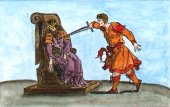
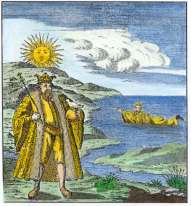
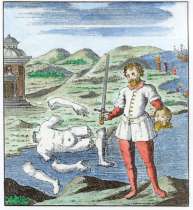
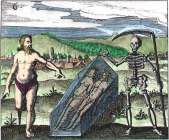
The alchemists were pretty gruesome about all the ways death/dissolution/dismemberment were effected upon the ego (as represented by the King, especially the Old King, in the emblematic and symbolic portrayals of the opus).  Although dense and obscure, I still find that the alchemical philosophers had the most to say about this stage of the Work.

Here are a few of the many emblematic depictions of the stage of the opus related to dissolution/dismemberment:


What we can see in these and other emblems is not just a drowning or destruction, but (from the perspective of the Other), a differentiation, a breaking down of things into their elemental parts (the drowning king symbol is a representation of dissolving).  As egos, we might experience this stage as catastrophic dissolution of our selfhood . . . but from the perspective of the unconscious Self, we are embarking upon a necessary  organization or re-shuffling.  I.e., what we experience as a profoundly debilitating "fever" is really the healing process of the autonomous Self self-regulating the organism (including its psyche).  The ego's perspective, I believe, is always an interpretive perspective . . . and a very colorful one at that.

The trick (and this is what I think Jung was on about with his "ego-fortification against the unconscious") is for the ego to recognize an "otherly" position in this process, a Self-oriented position that keeps one eye on the "progressiveness of descent".  The establishment of such a perspective is itself an act of faith . . . and I would bet that this is precisely where people who "find religion" find their religion.  It's the first step in surrendering to the Self.

But, of course, the process is infinitely more complex . . . specifically in the mechanism the Self-as-organism seems to apply as a kind of "lure" for the ego to follow it into what at first appears to be an oblivion.  I mean the anima/animus work.  The anima/animus stage always precedes and accompanies the dissolution of the ego.  My theory is that the ego must "fall in love with" the anima/animus as a preliminary step toward the recognition of the Self as both I and Not I.  I think the anima/animus figure is so wrapped up with sexuality and attraction, because it is a symbolic representation of our sexual instinct.  It woos us with all the force of pure, chthonic instinct (the reproductive libido, perhaps) . . . but it means to transplant this eventually to the Self, or if you prefer, to God.  The process also requires a substantial increase in consciousness . . . the consciousness required to differentiate all this.  Instincts operate unconsciously, after all . . . but the individuation work demands that we take increasing responsibility for who and what we (as egos) are.  I.e., this responsibility is consciousness.

And, even in collective culture, we think of falling in love as a kind of madness of dissolution or an absorption into the other.  Falling in love, really head over heals rather naively in love and the experience of "finding religion" have so much in common that the resemblance should be recognized and made meaningful.  There is no coincidence here.

And, not surprisingly, we see this dynamic in the ancient Goddess (and consort) religions in which the the sexual union of the Goddess and her consort represent the all-important fertility-spirituality of the land and culture.  Having gone through the Neoplatonic Christianization of sexuality (and the body and the Feminine), we tend to forget that sex is a religiosity among our species (addled as it may have become with modern neuroses).

So, as the individual (or the individual's ego) meets the fate of psychic dissolution at the hands of the individuation process, the deep inner search for love and connection is also at play.  Perhaps, to simplify drastically, the survival of the dissolution stage can be achieved only with the romantic devotion to love . . . the romantic love of the Other.  Those who cannot commit to this kind of love will languish or even perish in the dissolution.  The lover, on the other hand, accepts madness as well worth the price of coniunctio.  That is, to pin the tail on it, the definition of the Lover.

Quote from: rossweisse
No question there is more going on in the universe than our individual consciousness.  How does what the intellect knows get translated into something Ego can believe.  Forgive me if this is too basic.  I have only been at it a couple of years.

Not basic at all.  These are huge questions that we wrestle with for our entire lives.  I'm afraid, though, that I'm getting a little tripped up with the terms you're using here.  For instance, what precisely do you mean by "intellect" and "knows"?

As for what the ego can believe, in my opinion, the ego can and will believe anything that serves its short-term goals and facilitates its sense of self.  We tend to literalize and even imprison these beliefs, insisting upon their universality . . . but I generally think they are essentially "as-ifs" that get muddled in the process of literalization.  We (our egos) perceive everything, both the inner and the outer universe, through a sense of story.  That is, all information is condensed, filtered, sorted, valued, and reconstituted in such a way that it makes the most sense to us (based on our prejudices and experiences).  We will stick with a particular story as long as it works for us (serves our self-interest).  And when the story starts to seem insufficient to accord with our experiences, we are left with a handful of options: revise or recreate the story, deny that experience warrants such revision (making a tabooed dogma of the story), or, most commonly, a little bit of both.

I would say that the concept of neurosis is akin to the entertaining of a story of selfhood (an ego narrative) that no longer serves as a functional and adaptive strategy for survival.  It is like one's sense of self has become a dinosaur . . . but climate, resources, predators, etc. are making the big, lumbering, reptilian lifestyle impracticable.  The species of dinosaur has to either adapt or die out.  Or, more precisely, it does both.  That which cannot adapt dies out, and that which adapts lives on in a changed form.

This is what the symbolic allegory of the alchemical Old and New Kings represents, as well.

Yours,
Matt
You can always come back, but you can’t come back all the way.

   [Bob Dylan,"Mississippi]

Sealchan

  • Registered Members
  • Posts: 516
  • Gender: Male
Re: The Ego
« Reply #3 on: March 12, 2007, 01:44:19 PM »
In the simplest terms the ego is the label used to designate ourselves as a psychological point of reference.  It is generally recognized that in each human being there is an awareness, a consciousness.  This awareness has a "configuration" known as the personality.   Our shared ability to be conscious is colored with these differing personalities which give a first glimpse as to the complexity of that upon which our consciousness rests.  When Freud came along, we now had to consider our inner mental world as being composed of more than just our awareness.  In fact, there seems to be a certain scope or range of mental activity only part of which is actually available to our own conscious awareness in a direct sense.  That this is true was a profound realization and is still, to a large degree, not fully appreciated on any cultural level.

As I have come to understand it, for Jung the ego was the central authority associated with what is mainly conscious in the individual psyche.  It is a complex organization of some kind that gives the ego a measure of autonomy with respect to the rest of the psyche.  But the ego constellates (or is part of a larger constellation) other less conscious personalities including the shadow and the anima/animus.  The ego is an emergent development in the psyche which is, originally, in a state of relative unconsciousness.  The ego is the development of a separate psychic system for the manipulation of libido or psychic energy.  Libido is simply meant to represent the fact that our egos possess a certain power to cause things to happen or, rather, that our psyches exhibit an economy of psychic force which attaches itself to this or that content and makes available with it a level of value or preference.  Therefore, when we say we have a will to do something, then there is behind that the recognition of an amount of energy available in association to that something.  The ego-complex, in response to both the inner instincts and the outer environment, is an effort to garner the available libido to its own ends, usually an adaptation to the inner and outer worlds.  But the unconscious with its complexes also has a handle of energic resources and can, at times, overwhelm the ego-centered intentions.

The ego is also that to which we point when we say "me" or "I".  We, perhaps, flex our ego "muscle" when we proclaim such things as "I think; therefore, I am" or that we have, under the constitution "inalienable rights".  Western civilization has seemed to emphasize the separateness, power and responsibility of the individual giving the ego a stronger emphasis or value in cultural discussions, perhaps, than might be seen in other cultures.

My understanding of ego from a neurobiological perspective starts with a philosopher.  In Daniel Dennett's book Consciousness Explained this philosopher brings up the idea that consciousness and our sense of individual identity is not so much a thing in and of itself but a focal point for the narratives that we internally tell ourselves.  As such the ego would be the "center of narrative gravity".  This idea indicates that the embodiment of mind is not just in the brain, not just in the behavior of neurons, not in a specialized neural structure or even neural patterns of behavior, but is a cultural layer of interpretation embedded in the neural behavior that underlies language and other specific forms of cultural expression and knowing.  This would make the ego a truly abstract but still embodied notion whose body is in the nervous system and also in the cultural space of knowledge that arises from this.  Teihard de Chardin developed the notion of the noosphere to describe this extended "physical" reality of consciousness as not just the brain activity but all of the changes to the biosphere, geosphere, etc that are connected with consciousness.  To understand consciousness then is to explore this understanding as a collective truth as well as an activity supported by neural activity.

In archetypal studies involving comparative mythology there seems to be an association of the masculine (as opposed to the feminine) with the idea of ego.  That this is the case could be seen as symptomatic of predominantly patriarchal societies.  It may be the case, however, that there are also biological differences in the human sexes that also influence this distinction.  It has been proposed that there may be different styles of ego development such that the masculine heroic model of the ego which has seen the greater attention is complimented by a feminine style of ego development which is analogous but may exhibit inverted developmental properties.  Erich Neumann was one of the first Jungians to develop this line of thinking.

Matt Koeske

  • Management
  • *
  • Posts: 1175
  • Gender: Male
    • Useless Science
Re: The Ego
« Reply #4 on: March 12, 2007, 03:26:48 PM »
My understanding of ego from a neurobiological perspective starts with a philosopher.  In Daniel Dennett's book Consciousness Explained this philosopher brings up the idea that consciousness and our sense of individual identity is not so much a thing in and of itself but a focal point for the narratives that we internally tell ourselves.  As such the ego would be the "center of narrative gravity".  This idea indicates that the embodiment of mind is not just in the brain, not just in the behavior of neurons, not in a specialized neural structure or even neural patterns of behavior, but is a cultural layer of interpretation embedded in the neural behavior that underlies language and other specific forms of cultural expression and knowing.  This would make the ego a truly abstract but still embodied notion whose body is in the nervous system and also in the cultural space of knowledge that arises from this.

Dennett's books are on a long list of intended reading that I haven't managed to get to yet.  His approach to the ego sounds very similar to the one I've been taking intuitively.  I will have to move him to the top of my list.

Do you know of any other writers in the neurological/scientific camp that try to formulate ideas of consciousness using scientific/biological data?  I would like to start doing a survey of this field of thought in order to stay abreast of the biological thinking about consciousness and the brain.  My goal is to build a theory of consciousness and psychic structure that accords with the best scientific research.

Two of the key components of Dennett's ego theory that you mention have long held an appeal to me: narrative reality and abstraction/non-locality.  I am fascinated by the possibility that human beings have evolved what could be described as an "abstract organ".  This is currently the cornerstone of my thinking about cognitive structure, and I feel it can be used to explain a great deal about our consciousness and sense of self/reality.

Do you know of any websites that give more information on Dennett and his work?

Thanks,
Matt
You can always come back, but you can’t come back all the way.

   [Bob Dylan,"Mississippi]

Sealchan

  • Registered Members
  • Posts: 516
  • Gender: Male
Re: The Ego
« Reply #5 on: March 12, 2007, 05:07:13 PM »
I did a quick Google search which lead me just as quickly to Wikipedia (as it often does).  The Daniel Dennett write up connected his ideas to another of my favored authors, Gerald Edelman,  who actually is a neurobiologist who did some significant work on the Immune System which won him the Nobel Prize.

Gerald Edelman is difficult to read so I would try the easier books as per this excerpt from Wikipedia:

Quote
Edelman is noted for his theory of mind, published in a trilogy of technical books, and in briefer form for a more general audience in Bright Air, Brilliant Fire and more recently in Wider than the Sky. Topobiology contains a theory of how the original neuronal network of a newborn's brain is established during development of the embryo. Neural Darwinism contains a theory of memory that is built around the idea of plasticity in the neural network in response to the environment. The Remembered Present contains a theory of consciousness.

Now, to be honest, it has been awhile since I read Dennett so while I can confidently ascribe the idea of "center of narrative gravity" and also the idea that there is no homunculus in the brain but rather a whole crowd of relative homunculi (which idea gives rise to my "high resolution" centers of personality formation line when I interpret crowds in dreams) to Dennett, I'm extending that (at least in my memory although he could have drawn those same conclusions only I don't remember that so well) based on what I do remember from Teihard de Chardin's Phenomenon of Man.

Eric Kandel, whose textbook on neurobiology I am slowly wading through, wrote a kind of memoir with lots of technical stuff that seems to be regarded as highly readable and entertaining, In Search of Memory

Antonio Damasio is also very good.  His work makes the physical instantiation of Jung's feeling function a snap (although he doesn't acknowledge Jung at all to my knowledge).